If you publish for a living, you've probably watched your Google referrals slide for a while. The research shows how unevenly it has landed, and Chartbeat's split by publisher size, as 9to5Google reported it, is the clearest version:
| Publisher size | Google referrals lost over the period measured (Chartbeat, reported March 2026) |
|---|---|
| Small | 60% |
| Medium | 47% |
| Large | 22% |
The smaller you are, the harder it hit. Chatbots aren't filling the hole either, since in the same data they still sent less than 1% of the page views publishers got through referrals.
Media leaders don't expect a turnaround. The Reuters Institute's 2026 trends report, out a few months earlier, surveyed 280 of them in 51 countries. They expected search referrals to fall by 43% over the next three years. That report also carried Chartbeat data covering more than 2,500 news sites, and Google search referrals to those sites fell 33% in the year to November 2025.
AI summaries aren't the only cause, but nothing has changed the results page more in years. I'll cover how they soak up clicks, who takes the worst of it, Google's side and what's shifting this year. We checked every source on September 27, 2026.
The answer now sits above the link
The old deal was simple: Google showed you a list of pages, you picked one, and its publisher got the visit. A summary gives you the answer first, written from the pages that used to be the results, so you may never open one.
On September 27 we put 20 everyday questions of the kind publishers cover into Google, from "what is inflation" to "how to clean a cast iron pan," and every one came back with an AI Overview on top. The overviews cited 8.7 sources on average.
The overlap is what I'd look at. In 19 of the 20, the overview cited a site that also held a top-three organic spot below it. Here are six:
| Search | Sources cited in the overview | Top-three organic sites also cited |
|---|---|---|
| what is inflation | 7 | 1 of 3 |
| how to lower blood pressure naturally | 9 | 2 of 3 |
| what is a roth ira | 13 | 2 of 3 |
| how to clean a cast iron pan | 8 | 3 of 3 |
| best budget laptops | 5 | 1 of 3 |
| how many hours of sleep do adults need | 6 | 0 of 3 |
So ranking still gets you into the answer. What moved is where your reader stops. Pew Research followed the browsing of 900 US adults, and when an AI summary appeared they clicked a traditional result in 8% of visits. With no summary on the page, the figure was 15%.
Links inside the summary did even worse, at 1% of visits. And after a results page with a summary, Pew found, people were more likely to quit browsing altogether. We call this the summary gap: what your page puts into the answer, set against the readers it gets back. You'll see it widest on questions one paragraph can settle.

Built by the team that got cited in 48 hours.
Content generation, backlink building, AI visibility tracking, and Google rankings. One platform, zero guesswork.
Why informational publishers lose the most
Summaries are strongest where the answer is short and rarely changes: definitions and explanations, how-tos, and the simpler health or money questions. If your archive is full of those, you're exposed, since that's what a lot of publishers built their search traffic on.
In August, an SEO on r/SEO described exactly this in a client's data. Impressions and entity-based questions were both up, but clicks on informational keywords had dropped by almost 25%, and this was a client the AI summaries cited directly:
Are we optimizing for traffic anymore or are we just becoming unpaid content writers for Google's AI Overviews?
I have been analizing my clients GSC data recently and I noticed a weird thing which is impressions and entity base questions are way up but sit here is down by almost 25% on information keywords even though we are sighted directly in Ai su...
One reply described splitting the report by intent, and I'd copy it if your boss only looks at sessions. Commercial pages keep their traffic and conversion metrics. Informational content gets judged on whether summaries name the brand, and on whether branded searches and direct visits go up.
Size is the other factor, as Chartbeat's split showed. Big outlets tend to have more readers arriving through the brand, their apps and newsletters, or direct visits, so search was a smaller share of their traffic to start with.
The results page keeps moving the same way. Anything that lets a reader carry on inside Google's answer is one less reason to visit you, and in August Google began removing the "Show more" button from AI Overviews, so by default they now behave more like AI Mode.
What Google says
Google thinks the damage is overstated. Liz Reid, who heads Google Search, wrote in August 2025 that total organic click volume from Search had been relatively stable year over year. She added that Google was sending slightly more quality clicks, which means visits where the person doesn't hurry back to the results.
Publishers point out that Google shared no data for either claim. Every independent number here, from Chartbeat and Pew to publishers' own analytics, points the other way. Can both be right? Partly, I think, and your own analytics will tell you which side you're on. Total clicks across the whole web can hold level while those clicks move away from informational publishers toward other kinds of sites.
What's changing for publishers in 2026
Regulators and courts have started to push back. In June, the UK's Competition and Markets Authority put a new requirement on Google search:
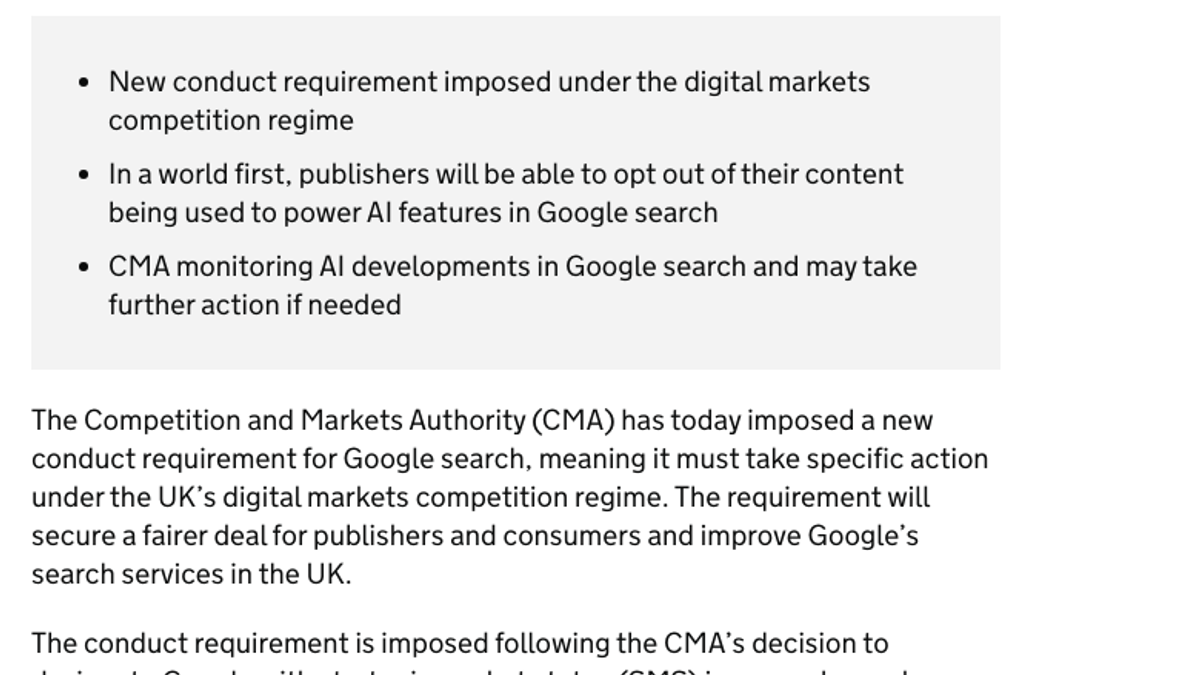
Google gets nine months to comply, and the rule also makes it credit publishers' content in AI answers with clear links. Before the CMA stepped in, the only way to stay out of AI Overviews in Google's results was to limit how much of your content Google could display at all.
Google moved before the deadline. On August 31, 2026, it rolled out a Search Console control that lets any site in the world exclude its content from AI Overviews, AI Mode and the AI features in Discover.
Don't confuse that with blocking Google-Extended in robots.txt, which still covers only Gemini model training. Google has said the block has no effect on AI Overviews, since those are part of Search. Our guide on whether publishers should opt out of Google AI search results explains how the new control works.
In the US, Penske Media sued Google over AI Overviews in September 2025, and French news publishers filed their own complaint in August 2026, shortly after AI Overviews launched in France. Payment is being tested too. In September, Google opened an invitation-only AI contribution pilot inside Search Console:
Google tests paying publishers for using its content in AI Overviews, AI Mode and Gemini through Search Console AI contribution pilot (something we actually spotted last April) https://t.co/k1iR58YyGo https://t.co/4j44Xii2CR
 Barry Schwartz@rustybrickSep 14, 2026
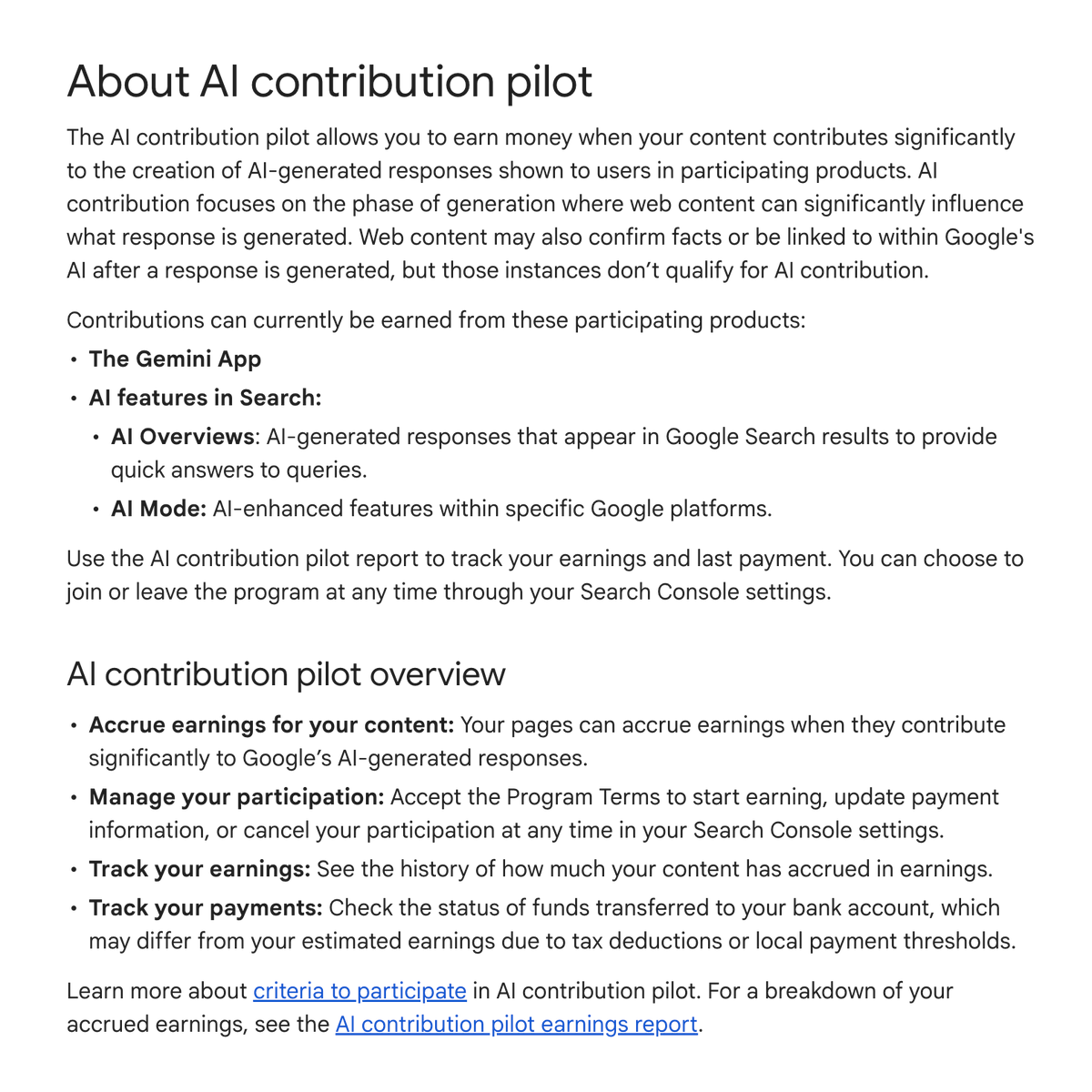
The terms are narrow. A page earns when it contributes significantly to an answer in AI Overviews, AI Mode or the Gemini app, and links or fact checks added after the answer is generated don't count. You'd see your earnings in a new Search Console widget, and the first reports called the payouts small next to ad revenue.
See your first AI citation report in under 5 minutes.
No setup calls. No onboarding meetings. Connect your domain and see where AI mentions your brand right now.
Not every publisher is losing
The averages hide real exceptions. In May, Lily Ray shared two publisher sites she'd audited that had grown over the previous six months, AI Overviews and all:
Not all publisher sites are seeing declines in organic traffic YOY... these are 2 sites I audited a little over a year ago - both have actually improved in traffic in the past ~6 months despite AI Overviews ramping up. All human-written, expert content focused on a specific https://t.co/TRAtIl8tBH
 Lily Ray 😏@lilyraynycMay 20, 2026

Both published human-written expert content on one specific niche, and both did well in Discover too. Ray also called that pattern rare, so I wouldn't treat it as a formula.
When a site holds up, it usually offers something a summary can't stand in for. Original reporting and first-hand testing give readers a reason to click through. Data they can't find anywhere else works the same way, as does a brand people search for by name. Our look at whether AI Overviews are killing website traffic has more evidence on who wins and who loses.
What this means for B2B content teams
If you run a B2B blog, you're a publisher too, and your informational posts sit in the same summary gap. A guide that explains a concept well may now be read mostly inside an AI answer.
You can check with tools you already have. For informational pages at a stable position, compare click-through rates from before AI Overviews appeared for their queries with the rates since. Then open Search Console's generative AI report, which shows the pages earning impressions in AI Overviews and AI Mode. When AI impressions rise and clicks fall, that page is feeding answers without getting the visits.
That changes how you measure. Alongside clicks, track whether your pages are cited and your brand is named in AI answers, and watch branded search. When we compared ChatGPT citations and AI referral traffic, most AI mentions came with no link to the brand's own site. If your traffic has already fallen, our checklist for traffic drops after AI summaries helps you separate summaries from other causes.
It changes what you write, too. Keep the informational posts that answer buyer questions, since they're what gets you cited, and link each to the commercial page it supports so the readers who click know where to go next. Then put more effort into pages that need a visit to work, like comparisons and pricing pages, or tools and original data.
By hand, this adds up. Eight solid articles a month take 16 to 24 hours to publish. Checking 50 questions on seven engines adds about six hours a week, and both figures are rough estimates.
RankControl's content engine writes each article against whatever already ranks for its keyword, then publishes it on your own domain. Every week, AI visibility tracking puts your 50 questions to seven engines and marks each one as mentioned, cited or both, so you can see where your content feeds answers even without the click.
You can track the summary gap on your own with Search Console and a spreadsheet. Or you can hand the publishing and tracking to RankControl's agents and keep your team's time for deciding which pages deserve a visit.
Your competitors are building backlinks while you read this.
Organic outreach, social mentions, and citations from Editorial Circle member sites, with managed backlinks available as an add-on. Grow your domain authority without running the campaign yourself.