Three proposals are sitting in your inbox. The cheapest is $2,500 a month, the most expensive is $12,000, and all three promise to get your company cited in ChatGPT. Then your CFO asks the question that stalls the whole thing: why don't we just hire someone?
It's the right question, and most of the advice on it is written by agencies. This post puts the AI search optimization agency vs in-house decision in numbers: what agencies charge in 2026, what a hire costs once you add everything up, where each one wins, and the setup most SaaS teams end up with.
The short answer
| Your situation | What usually fits |
|---|---|
| Nobody in-house has time, and you need work shipping within weeks | An agency, on a short first term with named deliverables |
| A marketer can own it for 10 or more hours a week | In-house, with tools doing the tracking |
| One owner with a few hours a week and under $2,000 a month to spend | A hybrid: an internal owner, software and occasional specialist help |
| You need press coverage or big link campaigns | A PR or outreach specialist for that part only |
The rest of this post is the reasoning behind that table.
What an AI search agency costs in 2026
There's no neutral price survey for GEO and AEO agencies yet, so we compared five pricing guides published by agencies in 2025 and 2026. They sell this work, so read them as asking prices, not audited data. What's useful is how closely they agree.
| Program size | Typical monthly retainer |
|---|---|
| Small business or entry program | About $1,500 to $4,000 |
| Mid-market | About $3,000 to $10,000 |
| Advanced, with PR and reputation work | About $8,000 to $15,000 |
| Enterprise | $15,000 to $50,000 and up, custom quoted |
Hourly consulting sits between $50 and $300 across the same guides. For a baseline outside the AI search niche, Ahrefs polled 439 SEO providers in 2024 and found agencies charged an average retainer of $3,209 a month, or about $99 an hour.
What does a retainer buy? One agency's guide splits a typical GEO budget roughly like this: 40 to 50% on content written to be cited, 20 to 25% on off-site presence such as reviews and mentions, and the rest on research and monitoring, with 5 to 10% set aside for technical fixes. That's a useful yardstick for reading proposals. If half the fee isn't going into pages and mentions, ask where it goes.
The market is also crowded with newcomers. SEO analyst Lily Ray joked in September about getting at least a dozen LinkedIn requests that month from people calling themselves GEO experts.
I've gotten at least a dozen LinkedIn requests this month from "GEO Experts" lol
 Lily Ray 😏@lilyraynycSep 2, 2026
What an in-house workflow costs
The in-house number people quote is usually just a salary, which undercounts it. The US Bureau of Labor Statistics doesn't track "SEO specialist" as its own job, but its closest category, market research analysts and marketing specialists, had a median wage of $78,760 in May 2025. That's about $6,560 a month.
Employers typically add 25 to 40% on top for payroll taxes and benefits. That's a rule of thumb, not a published figure, but it puts a mid-level hire at roughly $8,200 to $9,200 a month. A senior lead costs more: the top tenth of that BLS category earned over $155,000.
Then add tools. A hire still needs something to track AI answers. When we checked in late September 2026, Ahrefs' Brand Radar started at $50 a month for custom prompts. Semrush sold its AI Visibility Toolkit as a $99 add-on with 25 prompts and also bundled prompt tracking into its SEO + AI Search plans, from $199 a month for 50 prompts tracked daily. Most in-house setups land somewhere between $150 and $500 a month on tools.
| Monthly cost | Time to start | |
|---|---|---|
| Mid-market agency | About $3,000 to $10,000 | 2 to 4 weeks |
| Full-time in-house hire | About $8,400 to $9,700 with tools | 2 to 3 months to hire and ramp |
| Part-time owner with software | A few hundred to about $2,000, plus the owner's hours | 1 to 2 weeks |
So a full-time hire costs about the same as a mid-to-upper agency retainer. The difference is what you get for it, which is the next two sections.
Where an agency earns its fee
Agencies win on speed and range. A good one can start in a couple of weeks, while hiring and ramping a specialist usually takes months.
They also see many accounts at once. When an engine changes which sources it favors, an agency working across many clients notices sooner than a single in-house marketer watching one site. That pattern-matching is hard to hire for.
And some work sits outside your walls. Getting your product into third-party roundups and review sites is relationship work, and agencies with PR teams do it better than a content marketer can on the side. If your gap is mostly off-site, an agency or a PR firm is often the right call for that part.
The catch is knowledge. An agency learns your product from calls and docs, and it leaves with what it learned. There's a time cost on your side too: plan on two to four hours a week of your own team's time for calls and page approvals, even with a good agency.

Your competitors are getting cited by AI. You're not.
Every day without citation tracking is a day your competitors pull ahead in ChatGPT, Perplexity, and Claude.
Where in-house wins
Many of the pages AI answers cite for buying questions are ones only you can write well. In our look at what AI Overviews cite for B2B buying questions, vendors' own pricing pages, help docs and comparison pages were pulled straight into the answers. Writing those needs product access and sign-off on pricing, which an internal person has and an agency has to request.
The risk is concentration. If your one specialist leaves, the program stalls until you rehire, which is another two to three months. Writing the workflow down, and keeping the tracking in a tool instead of a personal spreadsheet, limits the damage. Our piece on whether companies still need SEO specialists covers what that hire should own.
In-house also keeps the knowledge. The list of buyer questions and the history of what got cited and lost stay with the company.
And it gets cheaper per page over time. An agency retainer usually rises as scope grows. An in-house owner who's already paid for gets faster as the workflow settles.
On r/b2bmarketing, a marketer asked whether anyone had changed their mind after trying both in-house and agency. Several people who'd done both described settling on the same setup: one person inside the company owning the strategy and priorities, with outside specialists brought in for depth.
Has anyone actually changed their mind after trying both in-house vs agency?
Feel like this debate never really gets resolved because everyone's experience is so different but I'm curious how people have actually landed on it. The in-house argument makes sense. You know the brand, feedback loops are faster, nobody's...
The hybrid most teams end up with
That thread lines up with what the numbers suggest. For most SaaS companies under a few hundred people, the setup that holds up is one internal owner, software doing the repetitive work, and specialists only where you need them.
The internal owner doesn't have to be full-time. Plan on four to six hours a week once things are running: picking the buyer questions, reviewing pages, fixing product facts and deciding what to write next. The software's job is the part that eats hours by hand, which is checking AI answers every week and drafting and publishing pages.
RankControl is built for this setup. We offer one flat plan at $400 a month: we track up to 50 buyer questions every week across seven AI engines, write articles against what already ranks, and publish them on your own site. Teams that want a person steering can add a Dedicated Strategist for $1,500 a month, who takes over market and competitor strategy and adjusts the monthly plan based on what ranks and gets cited. That comes to $1,900 a month with the strategist, below most mid-market retainers.
We won't do everything an agency does. RankControl runs backlink outreach from your own mailbox, but we don't handle press relations or analyst briefings, so if your gap is press coverage, budget for a PR specialist on top.
We think of the deciding factor as the exit test: if the relationship ended tomorrow, what would you keep? With in-house or hybrid work, you keep the pages and every week of tracking history. With some agency contracts, you keep the pages and lose everything else.
Red flags in an AI search agency pitch
Start with guarantees. Google's own page on hiring an SEO is blunt about it: "If they guarantee you that their changes will give you first place in search results, find someone else."
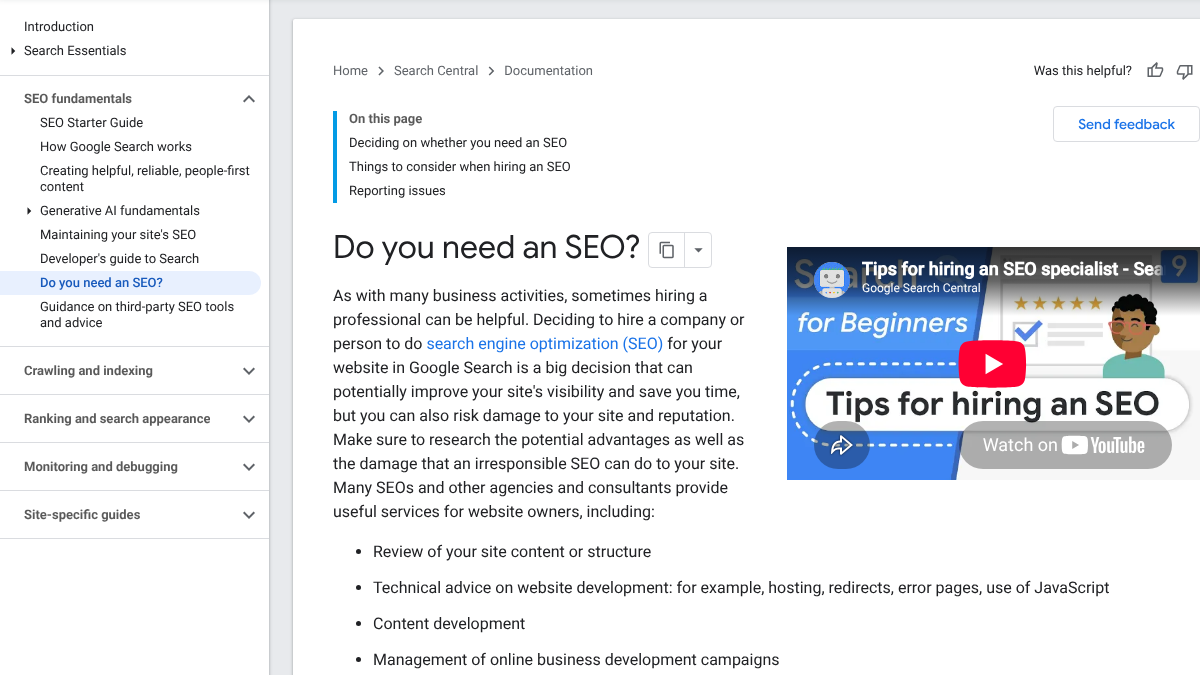
Bing went further for AI answers in its webmaster guidelines: "SEO does not guarantee rankings or traffic, and GEO does not guarantee grounding or citations in AI experiences." A pitch that promises citations in ChatGPT by a date is promising something neither Google nor Microsoft thinks anyone can promise.
The rest of the list is shorter than you'd think:
- A "proprietary method" they won't explain. Real AI search work comes down to pages and mentions, and none of it needs to be secret.
- A special relationship with OpenAI, Google or Perplexity. Google's page names claims of a "special relationship" as a warning sign.
- Reports without deliverables. One AI visibility tool recently showed agencies how to generate dozens of AI visibility reports in minutes, so a polished report proves little about the work behind it.
- Volume promises, such as a package of 60 AI-optimized listicles. Listicles are exactly the format Lily Ray flagged as losing citations, while ads for instant results kept multiplying.
Interesting how many more ads I’ve been getting for agencies promising instant results in AEO/GEO lately, while ChatGPT 5.6 cites Reddit way less, limits searches to trusted domains, listicles/comparison pages are dropping dramatically in citations etc. 🤔🤔🤔
Lily Ray 😏@lilyraynycAug 27, 2026Our post on whether GEO agencies are worth it goes deeper on vetting a specific shortlist.
200+ SaaS teams already track their AI citations.
They know exactly when ChatGPT mentions their brand, and when it stops. Do you?
If you do sign with an agency
Agencies can be the right call, and a good contract makes the difference. Four terms are worth insisting on.
Keep the first term short. Three months is enough to see whether pages ship and whether they get cited, and 12-month lock-ins mostly protect the agency.
Name the deliverables. The contract should list pages per month and who writes them, the buyer questions being tracked, and the off-site work planned, so "strategy" can't absorb the budget.
Ask for answers, not scores. Monthly reports should show the actual AI answers for your questions and the sources they cited, since a blended visibility score can move for reasons that have nothing to do with the work.
Own everything. The content, the tracking accounts, the question list and the data should be yours if you leave, which is the exit test in contract form.
Or skip the retainer altogether. In the same Ahrefs survey, agencies' average project fee was about $9,500, and the most common project band was $2,501 to $5,000. A one-time project to build your buyer question list and plan the first 20 pages, with your own team doing the work after, gets you the agency's pattern-matching without the monthly bill. For a team with an owner but no AI search experience, that's the version we'd pick.
How to decide in one meeting
Answer three questions with whoever signs the budget.
First, who inside the company can own this for at least four hours a week? If nobody can, an agency is your only real option for now, and a short contract lets you revisit that later.
Second, where's the gap? Look at what AI answers cite for your buyer questions today. If they cite your competitors' pricing and comparison pages, the gap is on your site, and in-house or hybrid is usually faster. If they cite review sites, roundups and press coverage, the gap is off-site, and that's where an agency or PR help earns its fee.
Third, what's the real budget? Under $2,000 a month points to hybrid. Between $3,000 and $10,000, an agency and a hire are both possible, and the first two answers decide it. Above that, many teams do both: an internal owner plus an agency for off-site work.
For a first-week plan once you've picked in-house, our guide for in-house marketers starting AI search work covers the setup. And if you're weighing an agency against software rather than a hire, our agency vs AEO software comparison covers that version of the decision.
Doing it yourself or handing it off
You can run AI search in-house with nothing more than a spreadsheet of buyer questions, a weekly check of each AI engine, a writer and an editor. For the first month, budget about 30 to 40 hours to build the question list and ship the first pages, then roughly 8 to 10 hours a week to keep checking answers and shipping pages.
Or RankControl can take the repetitive part. Our AI visibility tracking checks your buyer questions every week across seven AI engines, marks each answer as mentioning you, citing you or both, and records every source, so you can see which pages are winning. Our content engine writes the missing pages and publishes them to your own site, and the strategist add-on is there when you want a person setting direction.
How often does ChatGPT mention your brand?
Most founders have no idea. The answer might surprise you.