In July, a developer posted in r/SaaS that a complete stranger had just paid $9 for their Chrome extension. The post drew more than a thousand upvotes. One of the top replies had advice for the next step: find out who that customer is, because your best customers are hiding among your first ones. Another told them to work out which post, channel or piece of copy made the sale, since customer number two is somewhere in that trail.
I just got my first paying customer. ❤️
I know it's "just" $9, but I can't stop smiling. Over the last few weeks I've been building a Chrome extension for developers. There were days where I wondered if anyone would actually pay for something I made. Today, a complete stranger di...
Getting the first payment is harder than getting the first user, and it teaches more. Stripe's annual letter, published in February, says 20% of startups formed through Stripe Atlas charged their first customer within 30 days in 2025, up from 8% in 2020. The other 80% took longer, and Atlas companies are founders who incorporated because they meant to sell. This guide covers how to get your first paying customer for a SaaS product in seven steps, from choosing who to sell to through what to do once the money arrives.
Why your first paying customer matters more than your first user
The trap at this stage is what we call the polite yes. Someone watches a demo, says it looks great and that they'd definitely pay for it, then never does. People are kind to founders, and saying yes costs them nothing.
In an r/indiehackers thread from March, a founder listed the habits that got them zero customers across six products. One commenter admitted to exactly this mistake: three people had said they'd pay, and the founder counted it as validation until realizing they were just being nice. Rob Fitzpatrick's book The Mom Test is built around the same problem.
Money is the only answer that can't be polite. A card on file, a signed order form or a paid invoice tells you the problem is worth something. Everything below is aimed at getting to that answer quickly, even if it's a no.
Step 1: Pick one buyer who already pays for the problem
Who is already paying, in money or in hours, to live with this problem? Your first customer should be one of those people. Their current fix might be a manual workaround, an agency, a spreadsheet someone maintains every Friday or a competitor they dislike. Existing spending means there's a budget line to move, and a person who feels the cost.
Get specific. "Marketing teams" is too broad to find anyone. "Two-person marketing teams at B2B software companies with 20 to 50 staff who publish a blog" is narrow enough to name 50 people on LinkedIn this afternoon. You can widen the target after the first ten customers show you who buys fastest.
Step 2: Start with people who already trust you
A new product from a new company is a bet, and people bet on founders they know. In a Startup School episode released in June, YC visiting partner Max Kolysh compiled what dozens of YC founders did to land their first 10 customers. His summary was that customers one to three almost always come from the founders' personal networks.
Many founders start their customer search with cold email, LinkedIn, and prospecting tools. But the first 10 customers rarely come from a tool. It starts somewhere else: your network, showing up in person, and a willingness to do things that don't scale. In this episode of https://t.co/ioG6DRv2qa
 Y Combinator@ycombinatorJun 22, 2026

Work through that network in order: former colleagues, classmates and friends in the industry, then their connections. One founder in the talk got introductions to about half the customers she closed during her YC batch through second-degree LinkedIn connections. When you ask for an introduction, name the exact person and say why them. Kolysh's point about tools is worth repeating: prospecting software starts to matter after 10 to 20 good customers, not before.
Step 3: Go where the buyer already is
For customers four to ten, the same talk found founders doing things that don't scale. Paul Graham's 2013 essay Do Things that Don't Scale made the same argument with Stripe's early days. When someone agreed to try it, the Collison brothers didn't send a link later. They asked for the person's laptop and set them up on the spot.
In practice that means a few kinds of unscalable work:
- Small industry conferences, with 15-minute meeting slots booked back to back before the event starts.
- Dinners for six to ten people from your target customer profile.
- Communities where buyers already complain about the problem, from subreddits to trade association forums.
- One-to-one outreach that gives something first, like a short audit note about the prospect's own product.
Community work needs care. At least two founders in the YC talk found early customers through Reddit, one by messaging people who had complained about the problem in old threads. Another, a healthcare founder, got shadow banned along the way, so read each community's rules and answer questions instead of pitching.

Your competitors are getting cited by AI. You're not.
Every day without citation tracking is a day your competitors pull ahead in ChatGPT, Perplexity, and Claude.
Step 4: Ask for money before the product feels ready
Most founders wait too long to ask. The product will never feel ready, and every week of free usage delays the one answer you need. Put a price in the first real conversation, even if it's a founding-customer price.
A few structures make an early "yes" easier to say:
- A founding-customer price, lower than your future list price, locked in for the first year.
- A short paid pilot with a success measure you both agree on, like hours saved or reports shipped.
- A monthly plan with no annual commitment, so the first yes is a small one.
- Annual prepayment at a discount, which also funds your next few months.
Avoid giving the product away to your first customer. Free users can teach you about the product, but they can't tell you whether anyone will pay for it. If a prospect insists on free, offer a paid pilot with a refund if the agreed success measure isn't met.
Step 5: Make paying take one minute
The r/indiehackers list of mistakes included spending two weeks comparing payment processors before having a single customer. You don't need billing infrastructure for your first sale. Stripe's Payment Links let you sell a one-time product or a subscription through a hosted checkout page without writing code:
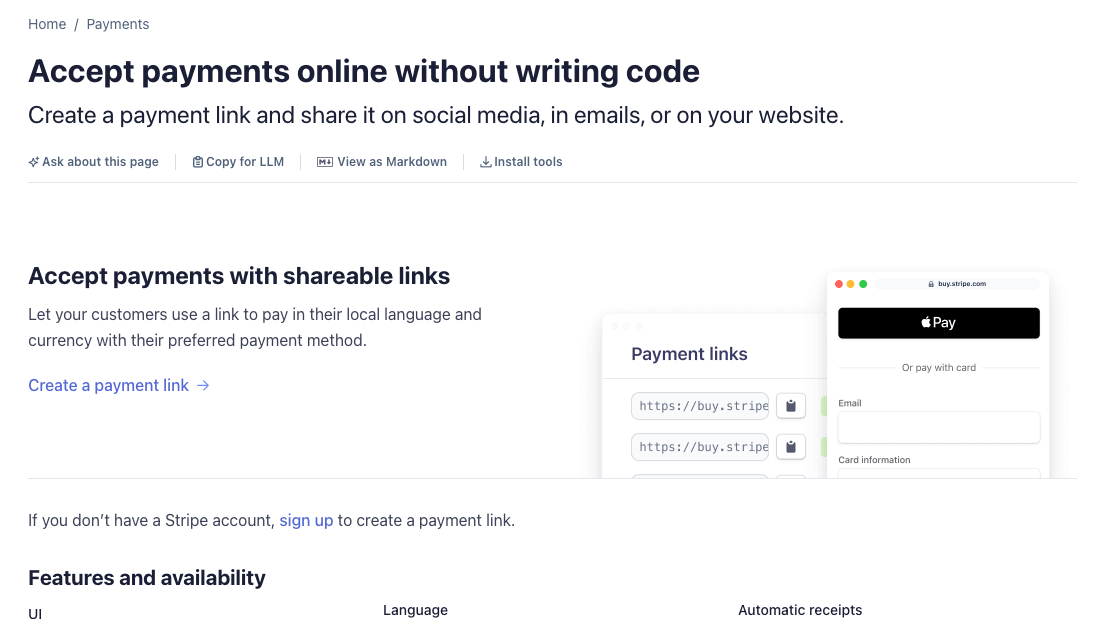
For a larger first deal, Stripe's documentation points to invoices for collecting one-time or recurring payments from a specific customer. Either way, have the link or invoice ready before the call. Our version of the Collison installation is simple: when someone says yes, send the payment link while you're still talking.
If you run a free trial, decide deliberately whether to ask for a card. A January 2026 study by Growth Unhinged, ChartMogul and ProductLed covered 200 B2B software products. Trials that required a card converted about 30% of signups to paid, more than five times the rate of trials without one. Only one in five trial products asked for a card, though, and asking for one usually means fewer people start. The typical company in that study already had $1 million to $10 million in annual revenue, so treat its rates as a guide rather than a target at customer number one.
Step 6: Run the sales call like a decision
A first sales call is a conversation about whether this person's problem is worth solving now. Open by asking how they handle the problem today and what it costs them. Then show only the part of the product that fixes it.
Say the price out loud, then ask a direct question: "Do you want to start this week?" If the answer is "let me think about it," agree on a specific date to talk again and send a short recap the same day. The YC talk suggested following up three or four times over a couple of weeks.
Listen for objections you hear twice. A price objection from two different people might mean the price is wrong, or it might mean you're talking to people without a budget. If the same missing feature comes up in three calls, move it to the top of the roadmap.
200+ SaaS teams already track their AI citations.
They know exactly when ChatGPT mentions their brand, and when it stops. Do you?
Step 7: Learn everything from your first paying customer
The replies to that r/SaaS post had it right. Once someone pays, find out why. Ask which post, search, introduction or conversation brought them in, and what almost stopped them from buying.
Onboard your first customer personally, and check in during their first two weeks. Ask whether they know anyone with the same problem, because a happy first customer is often the best source of your second. Our guides to getting the first 100 users and the channels that still work for B2B SaaS cover what comes after the first few customers.
Write down the exact words your first customers use to describe the problem. They're the words future buyers will type into Google and ask ChatGPT, and your website should answer them. G2 surveyed 1,076 B2B software decision makers in March 2026, and 51% said they now start their software research with an AI chatbot more often than with Google. The questions your first customers asked are the ones your content needs to answer. Our guide to getting cited in AI search before launch covers how to start early, and our founder's guide to AI search visibility covers what to do first. Those notes are also the start of what to hand your first marketer, which our guide to what SaaS founders should invest in before hiring a marketing team covers.
Doing it yourself or handing it off
Selling to your first customers is work only you can do. The content that brings in customers 20 through 200 is different, because it's slow, repetitive and easy to put off while you're on sales calls.
Done by hand, checking 50 questions on seven engines takes about six hours a week, and publishing eight solid articles a month takes 16 to 24 hours more. Those are rough estimates.
RankControl's AI visibility tracking runs your 50 questions every week on seven engines, marks each one as mentioned, cited or both, and records which competitors and sources each engine used. The content engine writes each article against the pages already ranking for its keyword and publishes it on your own domain.
You can write every article yourself between sales calls. Or RankControl's agents can write and publish the articles your buyers are searching for, while you spend your time with the customers.
How often does ChatGPT mention your brand?
Most founders have no idea. The answer might surprise you.