
Your team checks ChatGPT for your category on a Monday morning. You're third in the list, somebody screenshots it, and the screenshot ends up on a slide. Then a colleague in another country runs the same question and says you aren't in the answer at all.
So does ChatGPT give everyone the same answer? No. But the gap is smaller than the horror stories suggest, and it depends on what you sell. We ran eight buyer questions through ChatGPT's consumer app on November 6, 2026, from the US, the UK and India, and counted how many brand names changed.
What we asked, and where
Every question went in logged out, with web search on, in plain English and with no country named. We asked each one twice from the US and once each from the UK and India, so 32 answers in all. For each answer we wrote down the brands ChatGPT picked, then counted the new names. A new name is a brand that showed up in one answer and in neither US answer.
| Question | Second US answer | UK answer | India answer |
|---|---|---|---|
| Project management for a 10-person agency | 1 of 5 | 0 of 5 | 0 of 5 |
| CRM for a small business | 1 of 5 | 1 of 5 | 0 of 4 |
| Email marketing for an online store | 1 of 5 | 0 of 5 | 0 of 5 |
| Password manager for a small team | 0 of 4 | 0 of 4 | 1 of 5 |
| Live chat for a small business site | 0 of 5 | 0 of 5 | 1 of 6 |
| Accounting software for a freelancer | 0 of 5 | 1 of 5 | 3 of 5 |
| Invoicing app for a small business | 0 of 5 | 2 of 5 | 3 of 4 |
| Payroll software for a small business | 1 of 5 | 4 of 5 | 4 of 4 |
Each cell shows new brand names out of the names in that answer. The second US answer is compared with the first. The UK and India answers are compared with both US answers.
Treat it as a small sample. It's eight questions on one day, written in English, with search forced on and the country set by the network the request ran from. The raw answers are saved, and every count in the tables comes from those 32.
Asking twice from the same place changes about one name in ten
Add up the first column and a repeat from the same country brought 4 new names out of 39. On five of the eight questions, all four answers put the same brand first. Teamwork led for project tools, HubSpot for CRM, Klaviyo for stores, 1Password for passwords and Tidio for chat.
That's calmer than the biggest public test. SparkToro's January 2026 study, run with the AI tracking startup Gumshoe, had 600 volunteers run 12 prompts on three AI tools, close to 3,000 runs in all. The odds of getting the same brand list twice came in under 1 in 100. Our short "best X for a small business" questions did better, since four of the eight US pairs named exactly the same brands.
The volunteers in that study kept their own settings, personalized or not. So their number mixes chance, accounts and places together. Ours holds the account fixed, which is why we can pull location out by itself.
We'll show you exactly where your brand stands in AI search.
No commitment. $0 due today, cancel anytime. See how ChatGPT, Perplexity, Gemini, Google AI Mode, DeepSeek, Google AI Overviews, and Bing AI Summary talk about your brand today. Add Claude and Grok with your own API keys.

Where you ask from matters for money and tax
Look at the bottom three rows of the table. Accounting, invoicing and payroll moved with the country, and payroll moved almost completely. The first pick changed too.
| Question | US | UK | India |
|---|---|---|---|
| Accounting for a freelancer | QuickBooks in one run, FreshBooks in the other | FreeAgent | Zoho Books |
| Invoicing for a small business | Wave in one run, Zoho Invoice in the other | Xero | Zoho Invoice |
| Payroll for a small business | Gusto both times | Sage Payroll | Zoho Payroll |
The UK payroll answer retitled itself "Best payroll software for a small business in the UK" and listed HMRC's own free PAYE tool as the fifth pick. The India answer opened with "If you're operating in India" before it named anyone. Nobody told ChatGPT to do that.
A marketer on r/AskMarketing described the same thing after two weeks of working from Berlin. Two brands that always showed up in their US checks never appeared in the German answers, and a local rival they'd never heard of showed up almost every time. That's one account we can't verify, but it matches our payroll row.
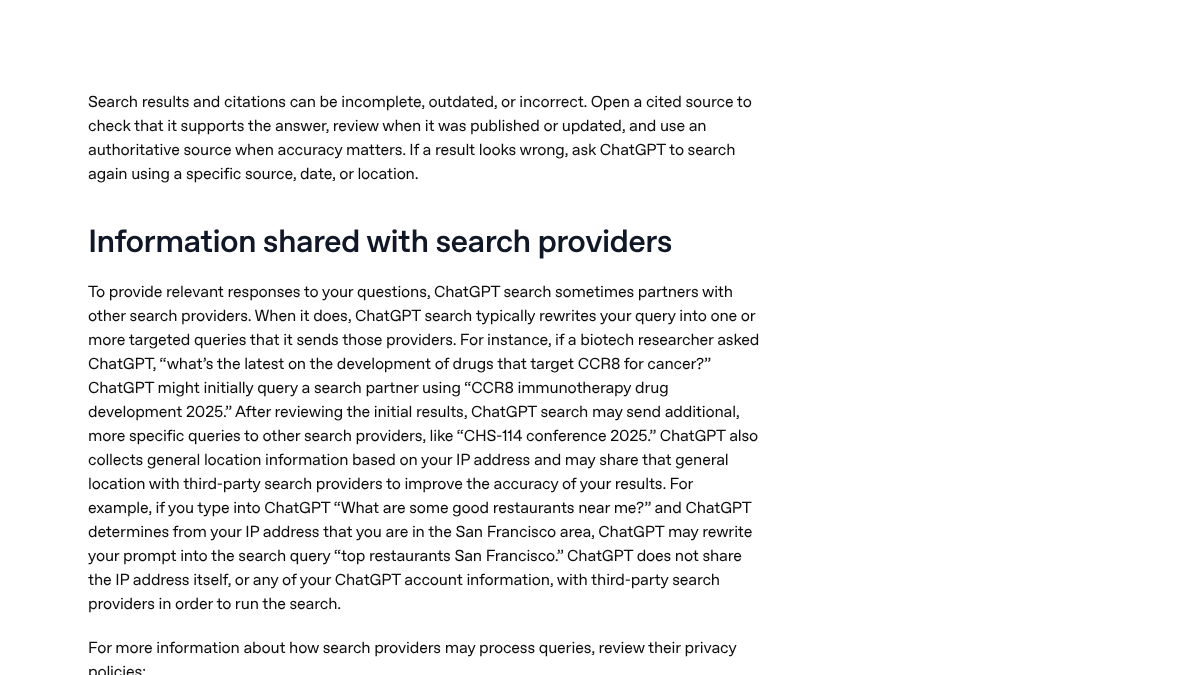
The reason is in OpenAI's help page, which says ChatGPT search "collects general location information based on your IP address" and may rewrite a prompt to include the place.
The other five questions barely moved. Group the rows and the pattern is plain.
| Question group | Second US answer | UK answer | India answer |
|---|---|---|---|
| Project tools, CRM, email, passwords and live chat | 3 of 24 | 1 of 24 | 2 of 25 |
| Accounting, invoicing and payroll | 1 of 15 | 7 of 15 | 10 of 13 |
In the first group, asking again from the US changed more than switching country did. In the second, the countries moved the lists far more than a repeat.
Three kinds of the same answer
"The same" can mean three things, and they didn't hold up equally. Among the eight US repeat pairs, four named exactly the same brands and two named them in exactly the same order. None cited exactly the same websites.
That last one is the biggest gap. Between two US answers to the same question, about four in ten cited websites matched. Between a US answer and a UK or India one, it was about three in ten, so the websites moved more than the brands did.
One cause sits in the same help page. ChatGPT search "typically rewrites your query into one or more targeted queries" before it fetches anything, and each run can write different ones. Different searches pull different pages, even when the shortlist that comes out is nearly the same.
So a brand can keep its place in the answer while the pages that put it there change from run to run. That's a reason to build mentions across review sites, forums and trade media instead of chasing one page. Our prompt set guide covers when a market needs its own questions, and the word-choice test covers the other big source of drift.
What your own account adds
We tested logged out. A signed-in ChatGPT has one more input, which is memory. OpenAI's Memory FAQ describes two settings, Reference saved memories and Reference chat history, along with a Temporary Chat that doesn't use or update memory.
That means someone who has spent months asking ChatGPT about your competitors may see a different shortlist than a stranger does. We couldn't test it without a real account's history, so treat it as a known unknown and not as a number.
One more limit sits on every result here. The app we used forces web search on. Plenty of free answers never search at all, as this look at memory and live search shows, and those answers come from what the model already knows.
The repeat-first test
A commenter on an r/Agentic_SEO thread about this exact question gave the best advice we saw. Get a baseline from repeats in fresh sessions before you blame location, personas or anything else. We call it the repeat-first test, and it takes four steps.
- Write the questions your buyers ask, with no country in them.
- Run each one three times from the market you sell in, logged out, and write down the brand list.
- Run each one from a second market and count the new names.
- If the second market's gap is no bigger than the repeat gap, the country doesn't matter for that question. If it's bigger, track that market on its own.
Our payroll row shows the second outcome. The repeat gap was 1 of 5 and the UK gap was 4 of 5.
Know exactly what AI says about your competitors.
RankControl's Recon Agent monitors competitor citations across ChatGPT, Perplexity, Gemini, Google AI Mode, DeepSeek, Google AI Overviews, and Bing AI Summary, plus Claude and Grok on your own API keys. See where they show up and you don't.

What to do with the result
A brand named in every run has a position you can trust. A brand named in two of four runs is on the edge, and one screenshot can't tell you which side of the edge it's on. Count appearances across runs and report that, not a rank.
Take a payroll vendor selling in the UK. Our UK run named Sage, BrightPay, Xero, QuickBooks and HMRC's free tool. A US check that shows Gusto in first place tells that vendor nothing about the answer its buyers see.
For payroll, tax, compliance and anything else a country regulates, treat each country as its own market with its own competitors. Everywhere else, one market is enough until the repeat gap says otherwise. Twenty questions, three runs each, is sixty answers to copy into a sheet, so budget an afternoon every time you want a fresh read.
You can do all of this by hand. Or RankControl's agents can do it for you, every month, while you focus on your product. We check your tracked questions across seven AI engines every week, and a new citation sends a notification. Our AI visibility tracking keeps the history, so you compare weeks and not single screenshots.
26 content formats. Published on your domain. Matched to your brand.
Guides, comparisons, listicles, case studies, and more. RankControl generates content that gets cited by ChatGPT, Perplexity, Claude, Gemini, Grok, Google AI Mode, and Google AI Overviews.