
A crawler block is invisible from where you sit. Your site opens fine in a browser while a firewall setting turns GPTBot away, and no analytics report shows the requests that never arrived.
So monitoring AI crawlers means two jobs, seeing who visited and finding who got turned away. I read the public pages of 11 tools that cover one or both. They are Cloudflare AI Crawl Control, Ahrefs Bot Analytics, RankControl, Screaming Frog Log File Analyser, Microsoft Clarity, JetOctopus, Oncrawl, Botify, GoAccess, Known Agents and VigIA.
I didn't test any of them. Everything below comes from vendor docs and pricing pages, checked on November 4, 2026. One result surprised me, since only 5 of the 11 name all three of Anthropic's crawlers on their own pages.
Which tool fits which job?
| If you are... | Best pick | Why |
|---|---|---|
| Already on Cloudflare | Cloudflare AI Crawl Control | Free on every plan, names all nine core bots, and can block |
| Already paying for Ahrefs | Ahrefs Bot Analytics | Free in beta on paid plans and flags spoofed bots |
| Short on budget with raw logs | GoAccess or Screaming Frog | Free to start, and logs are all they need |
| Buying for a large site | JetOctopus | The only enterprise log tool here with a public price |
| Worried a block is costing you citations | RankControl | Tests your site daily as each crawler and flags blocks |
| Running WordPress with no log access | VigIA | It runs inside WordPress and can block with a 403 |
| After verified identity on a small budget | Known Agents | Spoof checks and blocking from $29/mo; the free tier tracks 100K events without them |
How do the 11 tools compare?
| Tool | How data gets in | Checks real vs fake | Blocks or watches | Free tier or from | Best for |
|---|---|---|---|---|---|
| Cloudflare AI Crawl Control | Traffic proxied by Cloudflare | User agent only on free, verified on Bot Management | Both | Free, Pro $20/mo billed yearly | Sites on Cloudflare |
| Ahrefs Bot Analytics | Logs from Cloudflare, Vercel, CloudFront, AWS ALB or Fastly | Yes, against published IP ranges | Watches | Free in beta on paid plans, from $129/mo | Ahrefs users |
| RankControl | WordPress plugin, Cloudflare crawler data and a daily outside test | Not stated | Neither, but flags the block | $400/mo, 7-day free trial | Finding hidden blocks |
| Screaming Frog Log File Analyser | Log files you upload | Optional, against confirmed IP lists | Watches | Free to 1,000 log lines, then £99 a year | SEOs with raw logs |
| Microsoft Clarity | A connected CDN | "Verified bots" only, method not stated | Watches | Free | Clarity users |
| JetOctopus | Direct log integration | A fake-IP tool is listed, method not stated | Watches | From $349/mo billed yearly | Large sites |
| Oncrawl and Botify | Server logs | Not stated | Watches | Demo only | Enterprise SEO |
| GoAccess | Your access logs | No | Watches | Free, open source | Shell users |
| Known Agents | Cloudflare, AWS, Google Cloud, Vercel, Fastly, Akamai or a WordPress plugin | Yes | Both | Free to 100K events a month, then $29/mo | Verified identity |
| VigIA | PHP inside WordPress | Not stated | Both | Free | WordPress owners |
Know exactly what AI says about your competitors.
RankControl's Recon Agent monitors competitor citations across ChatGPT, Perplexity, Claude, Gemini, Grok, Google AI Mode, and Google AI Overviews. See where they show up and you don't.

What does monitoring AI crawlers have to do?
It has to do three things. It has to show volume by bot, prove a visit is real, and show where a bot was turned away. Most tools do the first, a few do the second, and almost none do the third.
The second one matters more than it sounds. OpenAI, Perplexity and Anthropic each publish the IP ranges their crawlers use, including Anthropic's bots.json list and OpenAI's bots page. Google and Bing verify through reverse DNS. A tool that reads only the user-agent string counts anyone who types "GPTBot" into a request.
One site owner on r/cybersecurity posted a decoy log where a single address sent 66 requests in 12 seconds under 25 AI and search bot names. The point was to verify by IP or reverse DNS, never by user agent.
From a decoy log: one scanner posed as 25 different AI and search bots in 12 seconds while hunting for .env files
I run decoy files on a few small sites and log what touches them. On Oct 25 one Google Cloud address made 66 requests in 12 seconds. Almost every request used a different bot name: GPTBot, ClaudeBot, GrokBot, DeepSeekBot, PerplexityBot, OAI...
A poster on r/SEO_for_AI matched a small site's logs against OpenAI's lists and found that 79% of the "GPTBot" hits weren't OpenAI. That's one small site, but it fits the decoy log.
One more rule helps. Google says Google-Extended "doesn't have a separate HTTP request user agent string", so a log can't show it. Any tool that lists it as a crawler it monitors is listing a robots.txt token. Our posts on auditing server logs and what agent traffic can't tell you cover the DIY route.
The tools, one by one
1. Cloudflare AI Crawl Control: free, if your traffic already runs through Cloudflare
If Cloudflare already sits in front of your site, start here. It costs nothing, needs no setup, sorts crawlers into crawlers, assistants and search, and lets you allow or block each one with a click.
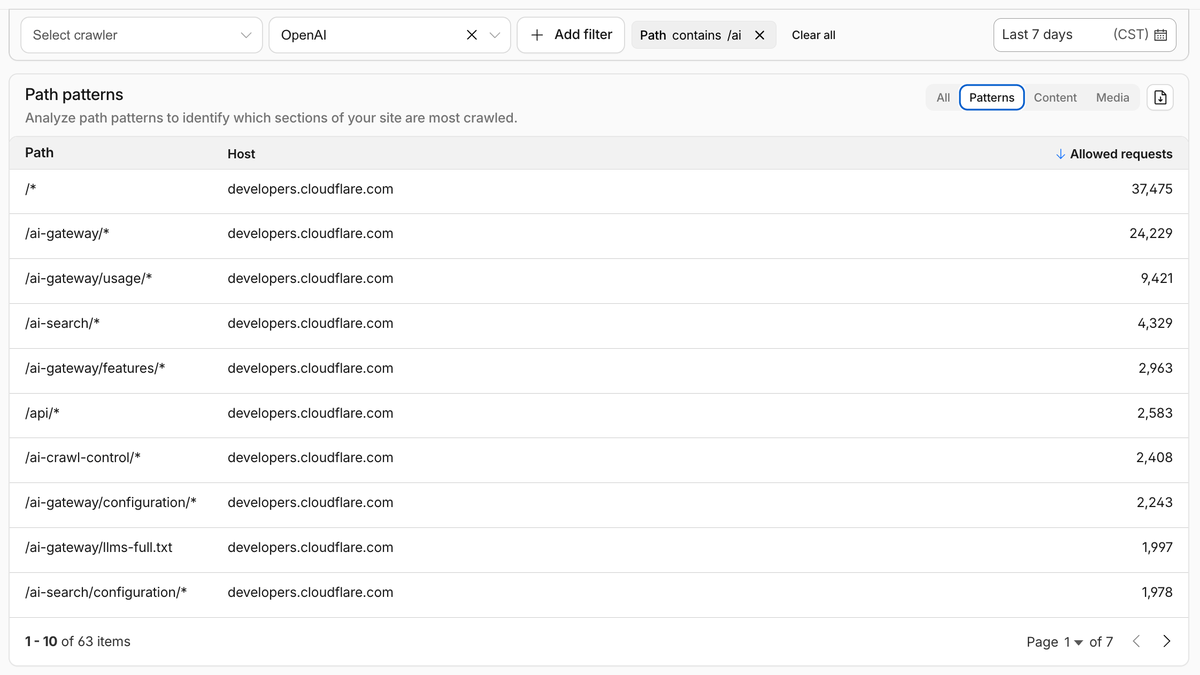
The catch sits on the free plan. Cloudflare's own docs say it spots crawlers by user-agent string, which "can be spoofed" in its words, and real verification needs the Bot Management plan. A publisher posted that the chart showed 105K failed Googlebot requests while the real Googlebot got no 403s all week, which he put down to fakes using Googlebot's name.
@burcs can you pls forward this feedback to the AI Crawl Control team? pasting below — this is my experience with https://t.co/ne8mr6hTY0 which is fully on Cloudflare This isn't urgent but wanted to give them some feedback! I am obsessed with getting my website crawled by https://t.co/urFoAEmPvF
 Nick Gray@nickgraynewsAug 11, 2026

Cloudflare's pages also disagree with each other about what a new domain gets by default. A July changelog says training and agent bots are blocked on pages with ads, and a November 2 docs page says everything is allowed. Open the setting and read it yourself.
2. Ahrefs Bot Analytics: server-side data if you already pay for Ahrefs
Ahrefs reads your CDN logs instead of running a script, groups bots by what they do, and labels visits that fail an IP check as spoofed. That last part is the feature that matters most here. Its help article is dated October 1 and covers Cloudflare, Vercel, CloudFront, AWS load balancers and Fastly.
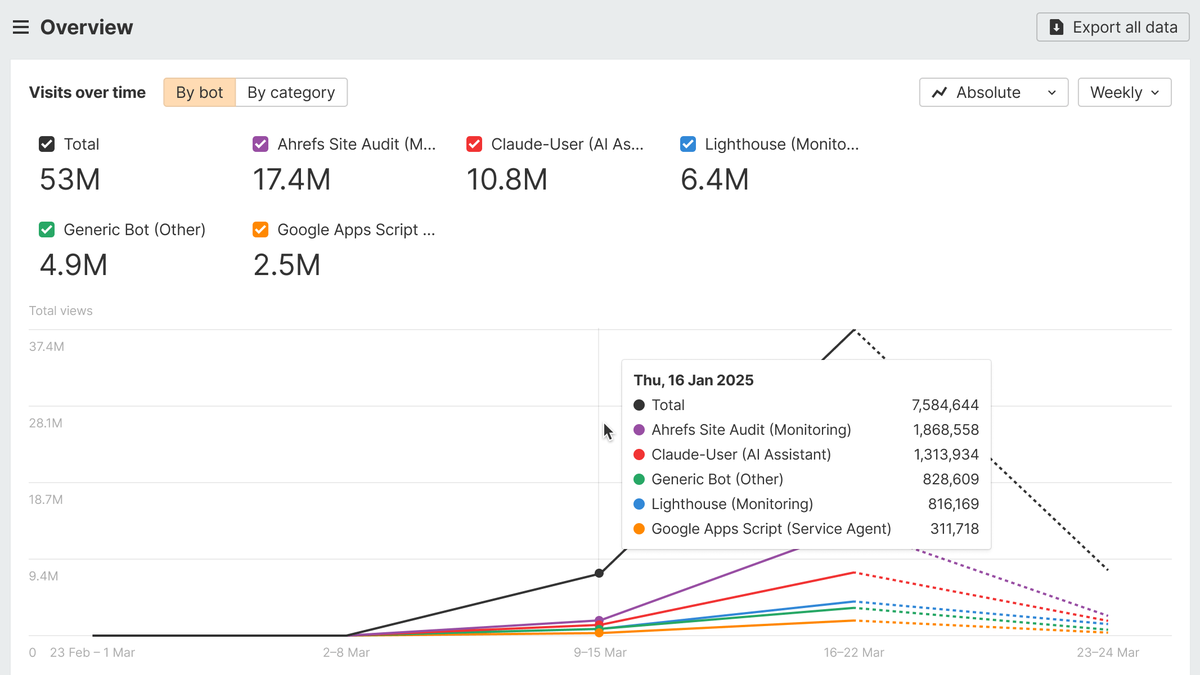
It's free in beta on every paid plan. The weak spot is the docs, which publish no crawler list and name only GPTBot and ClaudeBot as examples. Log setups can also add charges on your provider's side. Our guide to reading Bot Analytics walks through the reports.
3. RankControl: the daily test that finds a block your logs can't show
RankControl comes at the problem from the other side. Every day we visit your site pretending to be each AI search crawler, and if your firewall turns one away, the problem lands in Action Items with a notification. Our Analytics screen also logs crawler visits from the WordPress plugin and credits AI referrals to the assistant that sent them.
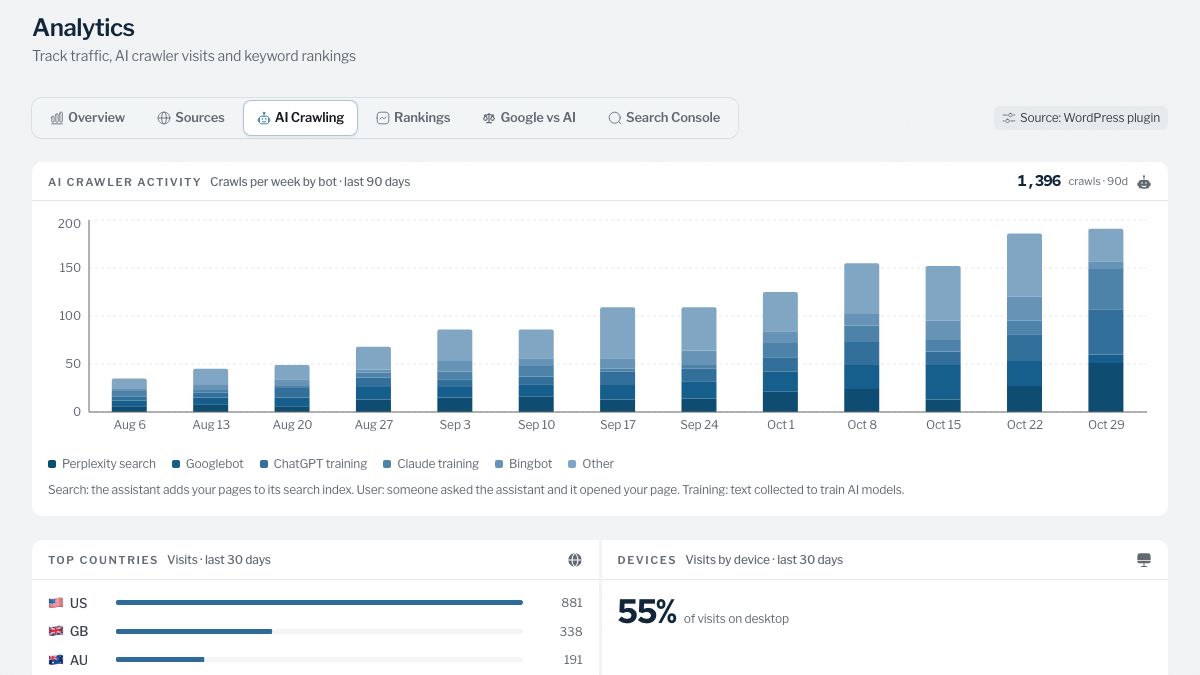
A log shows who arrived, not who the edge turned away, so this covers a gap the logs can't. A TechSEO thread asked whether anyone checks what crawlers get back from the CDN, and a reply warned that your own probe lands in your logs looking like the crawler.
does anyone actually check what AI crawlers get back from the CDN?
been looking at AI crawler access lately and i'm wondering how other people are checking this.i used to think robots.txt + the usual crawl checks were enough, but with Cloudflare/WAF sitting in front of the site, there's another layer that...
There are real limits. RankControl's public pages don't say whether bots are verified against IP lists, blocking isn't offered because the fix is a setting at your host or CDN, and RankControl is a content platform with the check built in, not a standalone monitor. The free AI Crawler Checker is a quick way to try the idea.
26 content formats. Published on your domain. Matched to your brand.
Guides, comparisons, listicles, case studies, and more. RankControl generates content that gets cited by ChatGPT, Perplexity, Claude, Gemini, Grok, Google AI Mode, and Google AI Overviews.
4. Screaming Frog Log File Analyser: purpose labels for the logs you can reach
This is a desktop app, so you export raw access logs from your host and drag them in. It has eight AI presets and a column that tells you whether each bot is training, searching or fetching for a live user.
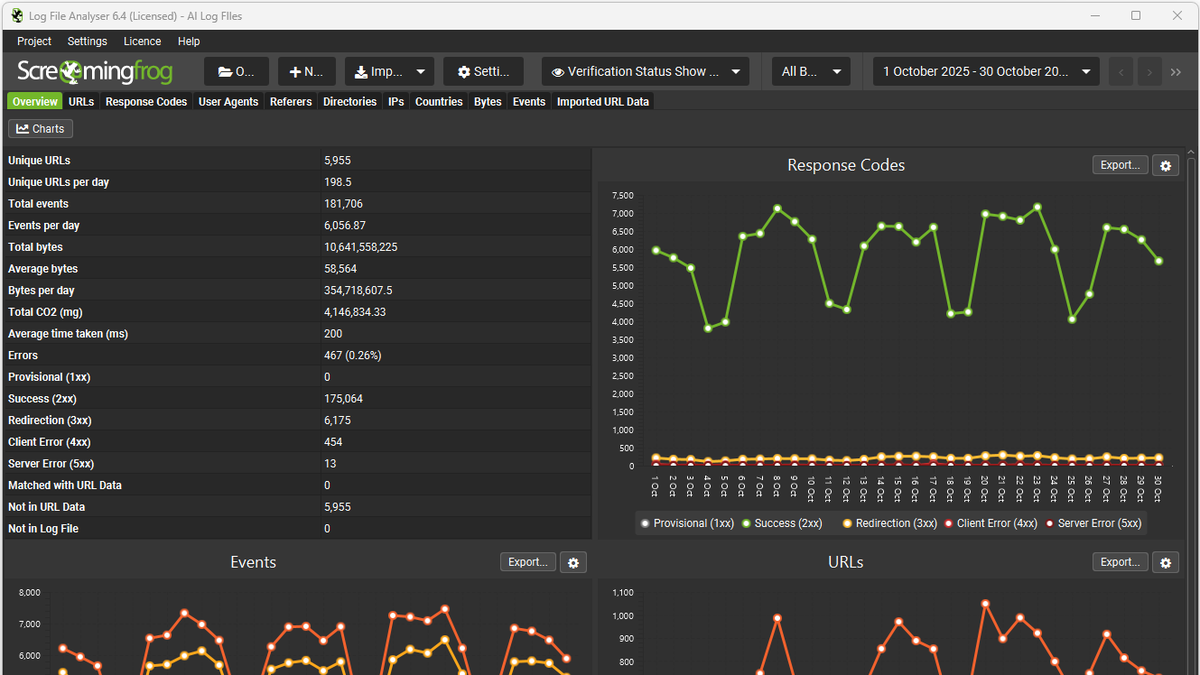
Bot verification against confirmed IP lists is an option you switch on at import. There's no preset for Claude-SearchBot, and the tool only watches. The free version stops at 1,000 log lines, which is enough to try it on one day of traffic.
5. Microsoft Clarity: free bot activity, if you connect a CDN
Clarity's bot view shows which operators hit which pages, with a purpose label and a card for robots.txt violations. It runs on a CDN connection, and the current WordPress plugin switches it on for you.
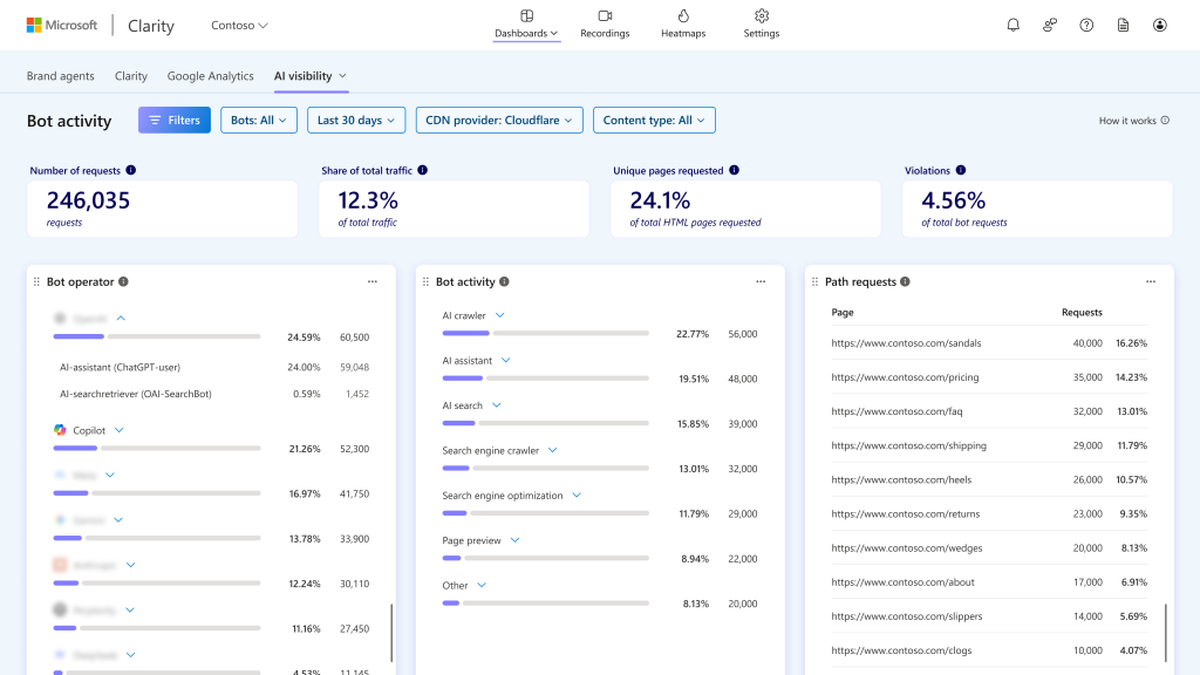
The pages I opened name no individual crawlers, and "verified bots" is never explained. Clarity's FAQ also warns that the CDN connection may add costs at your provider. Our post on Clarity's robots.txt violations goes deeper.
6. JetOctopus: the log analyzer with the price on the page
JetOctopus is a crawler and log analyzer with an AI Bots view, alerts and a year of retention. It's one of the few enterprise tools that tells you the price before a sales call.
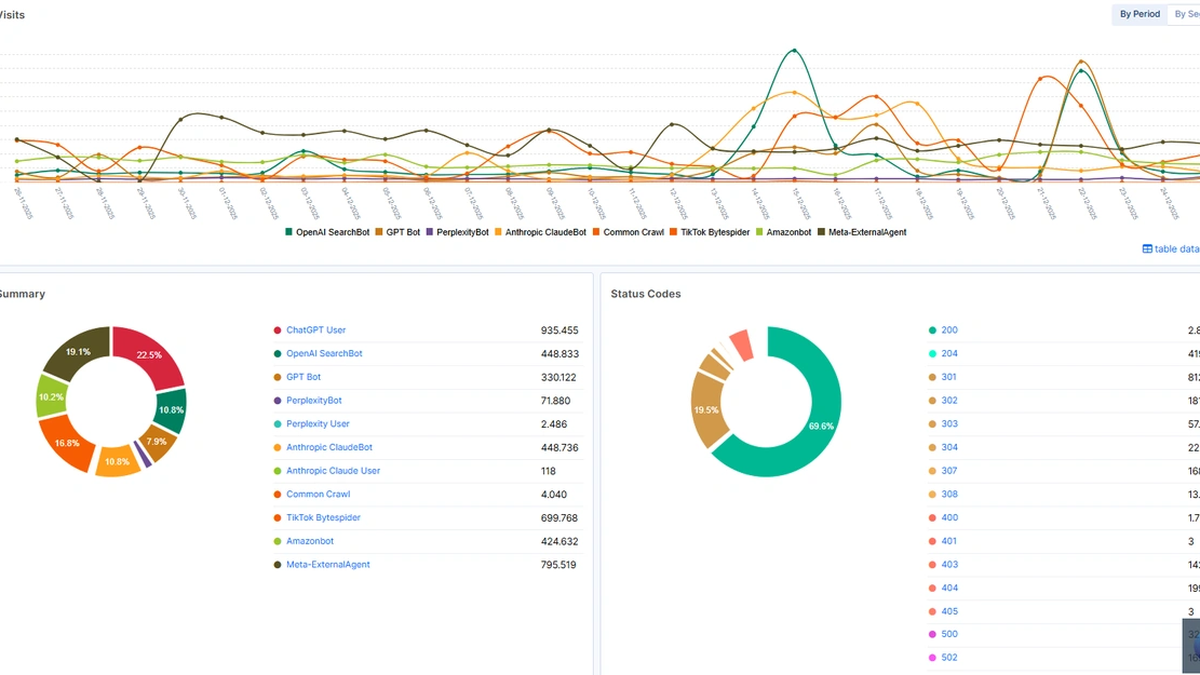
Its blog names seven AI bots and skips Claude-SearchBot and Perplexity-User. The pricing page lists a fake-IP validation tool without saying how it works. It watches and never blocks.
7. Oncrawl and Botify: enterprise log analysis, bought by demo
Oncrawl has a dedicated AI bots dashboard that separates training bots from user bots, though its page names operators and not user agents. Botify's page names GPTBot, ChatGPT-User, OAI-SearchBot, PerplexityBot, ClaudeBot and Meta-ExternalAgent and says there are more.
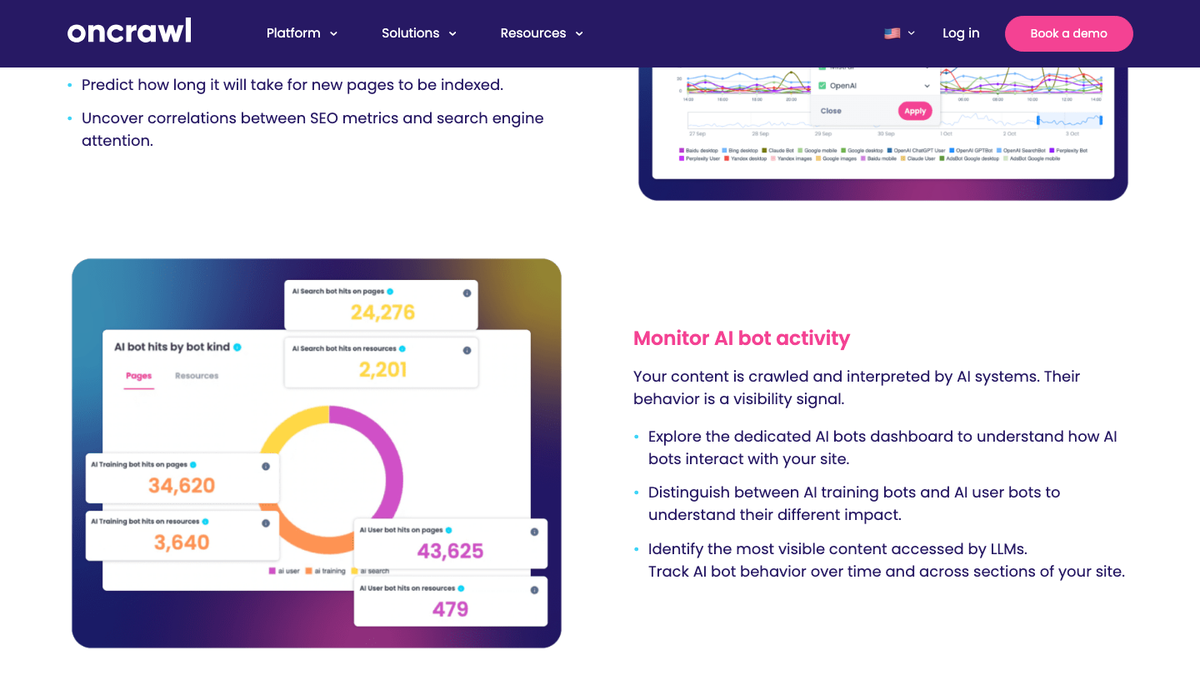
Neither shows a price, and neither says whether it checks for spoofed bots. Botify now sells itself as an AI search optimization platform, so it's partly a rival to RankControl. Both make sense if your company buys through sales anyway.
8. GoAccess: free, open source and fast
GoAccess reads your access logs in a terminal or an HTML report. Version 1.12, released September 16, 2026, added an AI Crawlers category, and its source lists 24 user agents in it, covering all eight OpenAI, Anthropic and Perplexity bots.
The category is one bucket, so assistants and training bots aren't split, and there's no IP check. Its man page names no AI bots, so read the release notes instead. If you have shell access and a log file, it costs you nothing to try.
9. Known Agents: verified identity and blocking from $29 a month
Known Agents, which used to be Dark Visitors, tracks more than 2,000 agents and pulls data from Cloudflare, AWS, Google Cloud, Vercel, Fastly, Akamai or a WordPress plugin. It verifies against spoofing and offers bad-bot blocking and automatic robots.txt.
The free tier covers one project and 100K events a month with automatic robots.txt; blocking and agent identification start on the $29 Startup plan. One warning comes from its own WordPress docs, since page caching can serve a page without running WordPress and then the plugin sends nothing for that request. For verified identity without a large bill it's hard to beat.
10. VigIA: a free WordPress plugin for sites with no log access
VigIA runs inside WordPress, keeps crawler visits in your own database, and can block with a 403 or write robots.txt rules. Its WordPress.org listing claims 60-plus crawlers and names 25, with 2,000 active installs and a 100% rating from 19 reviews.
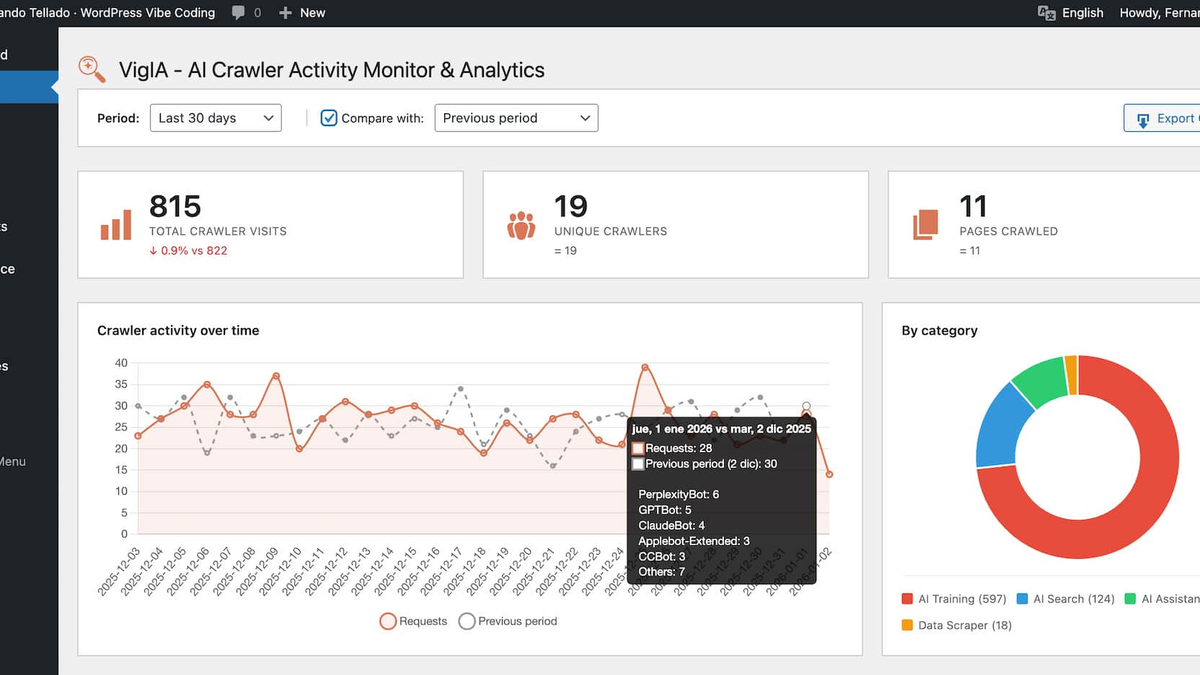
The caching limit Known Agents describes applies to any PHP plugin, and the listing says nothing about spoof checks. On shared hosting with no log access, it's the practical choice.
Which crawlers do the tools name?
I counted the AI crawler names on each tool's own public pages and marked the nine core bots. This is a count of what pages say, not a test of what each tool detects.
| Tool | Core bots named, of 9 | All three Anthropic bots | Perplexity-User |
|---|---|---|---|
| Cloudflare | 9 | Yes | Yes |
| VigIA | 9 | Yes | Yes |
| Known Agents | 9 | Yes | Yes |
| GoAccess | 8 as AI | Yes | Yes |
| RankControl | 9 across docs and analytics pages | Yes, on the docs page | Yes, on the docs page |
| Screaming Frog | 7 | No, no Claude-SearchBot | Yes |
| JetOctopus | 7 | No, no Claude-SearchBot | No |
| Botify | 5 | No, ClaudeBot only | No |
| Ahrefs | 2 given as examples | Not stated | Not stated |
| Oncrawl | 0, operators only | Not stated | Not stated |
| Microsoft Clarity | 0 | Not stated | Not stated |
Anthropic's own page lists three crawlers, so a tool that names only ClaudeBot is behind it. Perplexity-User, the fetch that happens when someone asks, is named by only 6 of 11. RankControl's analytics page alone names just four of the nine, so I counted from the docs page.
What no crawler tool tells you
A crawl isn't a citation. Microsoft Clarity's own FAQ says crawling reflects access to your content, not whether it was used or cited. A poster on r/SEO_for_AI put it plainly, that crawler counts are a diagnostic and not a score.
Split by purpose before you read a count. Training bots collect data, search bots build the index that decides whether you can be cited, and one r/SEO_for_AI poster calls user fetches the closest thing to a citation log a server gives you. Our guides to the complete AI crawler list and the ClaudeBot rules cover which to allow.
You can do all of this by hand with your logs and a terminal. Or RankControl can run the daily crawler test while you work on your product.

Your competitors are getting cited by AI. You're not.
Every day without citation tracking is a day your competitors pull ahead in ChatGPT, Perplexity, and Claude.