
Somewhere right now, in a founder Slack, someone is asking whether they need llms.txt, and three people are answering with three different blog posts. I know because I get this question weekly, and because we burned an actual quarter testing the thing properly. So here's the founder-to-founder version, answer first: yes, spend twenty minutes adding one, once, and then never think about it again. No, it will not get you cited in ChatGPT. And if anyone wants to charge you money for it, close the tab.
That's the whole verdict. The rest of this piece is why I hold it, and what I'd actually do with your next four free hours, because the interesting question was never really about the file.
The Thirty-Second Version of What This File Is
llms.txt is a markdown file you put at your domain root, listing your best pages with short descriptions, so AI models get a clean map of your site instead of parsing your navigation. The pitch: robots.txt was for search crawlers, this is for AI. It takes twenty minutes, there's a cottage industry of free generators, every founder community has debated it to death, and nobody in those debates ever brings logs. The pitch sounds completely reasonable, which is exactly why it spread faster than any evidence for it.
What Happens When Founders Actually Check
Here's my favorite piece of evidence from this month, because it's a founder doing what founders should do: checking. Someone asked r/SaaS whether anyone actually uses the file, and one founder answered with a story in two acts. Act one: they'd shipped llms.txt on July 31, pulled GA4, and found zero AI-referred sessions. Act two, after a commenter correctly pointed out GA4 can't see file fetches: they pulled their nginx logs. Seventy total requests to /llms.txt, of which 32 were their own curl checks, and nearly all the rest were site scanners like BuiltWith and Chrome Lighthouse. AI crawlers fetching the treasure map: essentially zero.
Are any founders actually using llms.txt?
I’ve been reading more about llms.txt and I’m curious how founders are actually using it. If you’ve added one to your startup: What do you include in it? Do you write it manually or generate it? Have you noticed any difference in ChatGPT, P...
That matches what we found at bigger scale. We ran llms.txt on 12 sites for 90 days with a citation baseline and a fixed prompt panel, and the file produced a combined 1.5% citation change, comfortably inside week-to-week noise. The major training crawlers barely touched the file. OpenAI's search crawler fetched it on some sites, Google indexed it like any text file, and none of that fetching correlated with a single citation moving. We published a map; the pirates mostly didn't pick it up, and the ones who did still dug wherever they wanted.
And the SEO old guard? An r/SEO thread bluntly titled "Is llms.txt file a scam?" got its top answer in four words: yes, to the title. My favorite comment in there is from someone who'd just come out of a live session with Google folks in Toronto, where this exact question came up. The answer from the people who build the search engine: the file is neither needed nor required, it won't help you and won't hurt you, make one if it gets your manager or client off your back.
Is llms.txt file a scam?
Been researching ways to make my website more visible in AI search (ChatGPT, Claude, Gemini...). Came across llms.txt and have seen a lot of contradictory posts about it. Anyone working at Anthropic, OpenAI or Google that can confirm if it'...
"Make one if it gets your manager off your back" is honestly the most accurate product description llms.txt has ever received.
How often does ChatGPT mention your brand?
Most founders have no idea. The answer might surprise you.

One Sec, Though, Because I Owe the Other Side a Fair Hearing
The believer case is louder than the evidence case, and it isn't all hype, so let's steelman it properly.
Exhibit one: Marc Lou, who ships more indie SaaS than most agencies ship landing pages, published bot data from one of his products claiming OpenAI and Anthropic fetched his llms.txt heavily, alongside stats about markdown crawling and his /mcp endpoint being the most-crawled page on the site.
AI bots data for TrustMRR: - OpenAI and Anthropic used llms.txt heavily to answer users, index pages, and train their models. - Markdown pages are crawled 50% of the time; AI bots still use HTML. - /mcp is the page that ChatGPT/Claude crawl the most to answer users. n=1M+ AI https://t.co/L2ohPXkbgt
 Marc Lou@marclouAug 13, 2026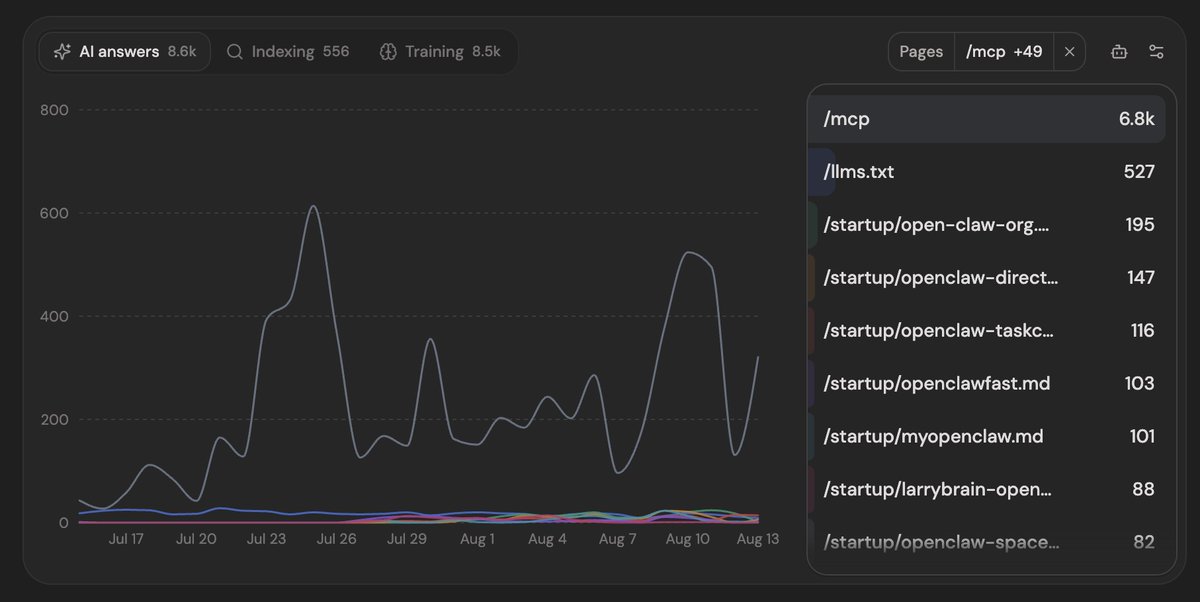
I take this seriously rather than literally. Fetch data from a developer-tool site with an MCP server describes the agent-first corner of the internet, where AI traffic genuinely concentrates, and it lines up with the one consistent exception in our own logs: search crawlers, on some sites, do fetch the file. What none of this shows, still, is the fetch turning into citations that wouldn't have happened anyway. Fetched and used are different claims, and only the first one has receipts.
Exhibit two: the Lighthouse audit. This tweet made the rounds hard, and the framing writes itself: Google added llms.txt to a Lighthouse audit, therefore Google is now checking whether your site speaks AI.
Google just made it official. They added llms.txt as a Lighthouse audit. That means Google is now checking whether your website has a file that helps AI agents understand what your business does. Think of it like robots.txt was for search crawlers. llms.txt is the same thing
 Ken Savage@kensavageMay 21, 2026
There's one carve-out I'll grant the believers fully, and it matters if you're building developer tools. If your SaaS is agent-first, meaning you ship an MCP server, an API agents actually call, markdown versions of your docs, that corner of the internet really does behave differently. Marc's most-crawled page being /mcp is the tell: when your buyers are increasingly agents acting for humans, machine-readable everything stops being a courtesy and becomes packaging, and llms.txt rides along as part of that package. For a dev-tool founder I'd move the file from "twenty minutes, whatever" to "yes, obviously, alongside the rest of your agent surface." For the other 95% of SaaS, selling to humans who read websites, the evidence stays where the logs put it.
Now connect the two exhibits, because there's a genuinely funny detail hiding in this month's evidence. Remember the r/SaaS founder's nginx logs? The things actually fetching his llms.txt were site scanners, prominently including Chrome Lighthouse. So the audit is real, and its most measurable effect so far is that the auditing tool became the file's most reliable reader. An audit checkbox manufactures demand for the checkbox. It says nothing about ranking, and Google's own people, in the same month, kept saying the file carries no weight in Search. Both things are true at once, and only one of them affects your citations.
Why Founders Keep Doing It Anyway
I don't think founders add llms.txt because they've weighed the evidence. I think they add it because it's the perfect founder task: twenty minutes, produces an artifact, feels technical, and comes with a plausible story about being early to a standard. When you're staring at a growth chart that won't move, a checkbox you can complete today beats a strategy that pays out in a quarter. I've fallen for this exact trap with other checkboxes, so no judgment, just recognition.
The ecosystem knows this about us, by the way. There are free llms.txt generators marketed with lines like "send this to anyone who says you need one," built on analyses of a hundred thousand domains. When the tooling around a standard is this mature while the evidence for the standard is this thin, you're looking at a market for reassurance, and reassurance sells regardless of whether the engines are buying.
Wondering why I still say make the file, given everything above? Because the twenty-minute version has a real return, and the return has nothing to do with crawlers. It permanently ends this debate inside your company. Your co-founder stops forwarding you LinkedIn posts about it. The agency you're evaluating can't use it as a wedge. An investor doing diligence sees it and moves on. And you stop rereading posts like this one. Twenty minutes to retire a recurring conversation is genuinely good ROI; it happens to be organizational ROI rather than search ROI.
My Actual Answer, With Conditions
So, should SaaS founders use llms.txt in 2026? Here's the decision the way I'd give it to a friend over coffee.
Make the file if: you can do it in one sitting, and you'll generate it from your sitemap or docs so the URLs don't rot. Treat it as a courtesy file, the same category as a well-made 404 page. Done properly it also doubles as a decent forcing function, since writing a one-line description of your product and picking your ten most citable pages is a positioning exercise wearing a technical costume.
Skip it, loudly, if: anyone is charging you for it, it's listed as a deliverable in an "AI SEO package," it would displace even one afternoon of real work, or you'd be adding it instead of checking whether AI crawlers can reach your site at all. The file's real cost hides past the twenty minutes: the sense of completion it hands you while the actual blockers sit unexamined.
And once it's live, don't maintain it beyond regeneration when your sitemap changes. A file no engine documents reading does not deserve a recurring calendar slot.
If You Do It, Do It Like an Experiment
One of the more thoughtful replies in that r/SaaS thread reframed the whole exercise in a way I wish more founders would steal: treat llms.txt as a controlled discoverability experiment instead of an SEO switch. The protocol costs almost nothing on top of the file itself. Put in a one-line definition of what your company does, canonical URLs for your product and docs, your key use cases, and only the pages you'd want quoted in an answer. Generate it from a small source file so the URLs don't drift when your site changes. Then, before you publish it, record ten fixed buyer prompts in ChatGPT and Perplexity, noting whether your domain gets named or cited. Re-run the same prompts monthly.
Do that, and whatever happens, you've won. If citations move, you're one of the first founders on the internet with actual before-and-after data instead of vibes. If nothing moves, which is what every measured test so far predicts, you now hold your own evidence, your team stops relitigating the question, and you've accidentally built the fixed prompt panel you needed anyway for the work that does matter. The experiment is worth running even though the file isn't worth believing in, which is a sentence that describes a surprising amount of marketing.
15 hours a week manually. Or 15 minutes with RankControl.
Track citations, monitor competitors, and fix content gaps across every AI search engine. Automatically.

What I'd Do With Your Next Four Hours Instead
The founder version of AI search work, ranked by measured payoff per hour, based on what actually moved citations in our test and everything we've tracked since.
Hour one: verify crawler access. Check your robots.txt and your CDN or firewall bot rules for blocks on GPTBot, OAI-SearchBot, ClaudeBot, and PerplexityBot, then confirm with your server logs that they're actually reaching pages. In our 12-site test, fixing access produced the single biggest citation lift of anything we tried. A blocked crawler makes every other optimization decorative.
Hour two: make your best three pages liftable. Answer-first openings, headings shaped like real buyer questions, dates that tell the truth, specifics an engine can verify. Three pages done properly beat thirty pages sprinkled with adjectives, because engines quote passages, and quotable passages are a writing decision.
Hour three: build your fixed prompt panel. Write down the fifteen questions a buyer would ask an AI before finding you, run them in ChatGPT and Perplexity, and record who gets named and cited. Without a before-picture you're doing all of this on vibes, and vibes are how the llms.txt debate got this far in the first place. This is the instrument we run weekly across six engines, and a founder can start the manual version tonight.
Hour four: go answer questions where engines actually look. The best advice in that r/SEO scam thread had nothing to do with files: one commenter described how genuinely answering questions in their field on Reddit did more for their AI visibility than anything on their own site. Community threads are among the most-cited sources in AI answers, and presence there is earned, slowly, by being useful rather than promotional.
Notice what all four have in common: measurable effects and zero checkbox dopamine. That's roughly how you can tell they work.
When I'd Change My Mind
I try to attach an expiry test to every "no" I publish, because this space rewrites itself twice a year, and this verdict has one. I flip to recommending llms.txt the week a major engine documents the file in its retrieval pipeline, or the week large-scale logs show the big crawlers reading it and citation changes tracking its contents. Either would show up fast in crawler logs and tracking panels. Two model generations and a retrieval rewrite later, with a Lighthouse audit thrown in, neither has happened, and a standard that's still pre-evidence after two years of advocacy has told you something about its trajectory.
Until then: twenty minutes, once, generated from your sitemap, and then back to the work that shows up in the numbers. Your future self, staring at a citation trend that finally moved, will not remember the file either way.
AI search traffic grew 835% this year. Is your content ready?
RankControl generates 26 content formats optimized for ChatGPT, Claude, and Perplexity. Published on your domain, matched to your brand.