
Scrunch changed owners in June, so every review dated before then describes an independent startup. Sitecore, the enterprise content management company, announced on June 3, 2026 that it had bought the startup. MarketingTech News reported that the terms weren't disclosed.
That matters for RankControl vs Scrunch, because the two now come from different places. Scrunch sits inside a company that sells to large marketing departments. RankControl is one flat plan for a team that wants articles written, published and tracked.
This page compares those two products on the same yardsticks. I read Scrunch's pricing page, FAQs, product pages and launch posts on November 6, 2026. Every Scrunch detail below comes from those pages, from Sitecore's documentation, or from a named review.
The short answer
For a team that wants articles written, published and tracked for one flat price, the best pick is RankControl. Scrunch's Core plan measures how AI engines talk about your brand, audits a few pages and drafts a little content. Then it leaves the publishing to you.
Scrunch is a measurement platform that has been adding fixes. RankControl is a content pipeline with the measurement built in. With Scrunch you read the report and then write the page, and with RankControl the page arrives drafted.
| Scrunch | RankControl | |
|---|---|---|
| Price | Core $250/mo for one brand; Enterprise custom | $400/mo or $4,000/yr, one plan |
| Engines on the entry plan | ChatGPT, Perplexity, Google AI Overviews, Copilot | ChatGPT, Perplexity, Claude, Gemini, Grok, Google AI Mode, Google AI Overviews |
| Tracked volume | 125 prompts, 5,000 responses a month | 50 queries, each on every engine |
| Check rhythm | Daily for 14 days, then every 72 hours | Weekly |
| Writing | Content Generation (basic on Core), 1 page optimization a month | Up to 100 pages a month across 26 formats |
| Publishing | Copy or download as HTML or Markdown, then publish from your CMS | Native posts through 9 destinations |
| Links | Not listed on the pricing page | Outreach drafted from your own mailbox |
| Seats | 5, extra seats $25/mo each | 5 |
| API, MCP, CLI | Enterprise only | Included |
| Trial | 7 days, card required | 7 days, card up front, $0 today |
Checked on November 6, 2026 against each vendor's pricing page and docs.
Who owns Scrunch now
MarketingTech News said Sitecore plans to build Scrunch's recommendations into its content management, marketing and digital asset products. Scrunch still sells on its own site, with a 7-day trial and a $250 Core plan, so a new buyer on November 6 could sign up without talking to sales.
What should a small team take from that? The roadmap now answers to a company whose customers run very large sites. Scrunch's own home page leads with its Agent Experience Platform, and the pricing page puts that platform on Enterprise. Core shows a dash.
Agent Pages is the part of that platform you can buy today. Scrunch's September 22 launch post says it serves an AI-readable version of your pages to verified AI agents at the edge, with no change for human visitors. The post says you ask sales about it.
The proof Scrunch leans on is a 364% rise in brand presence for non-branded prompts. MarketingTech News traced that number to Akamai comparing pages with the platform against similar pages without it. It's one giant site's own before-and-after, so read it as a good sign for that kind of site and not a forecast for a 40-page one.
15 hours a week manually. Or 15 minutes with RankControl.
Track citations, monitor competitors, and fix content gaps across every AI search engine. Automatically.

What the $250 plan includes
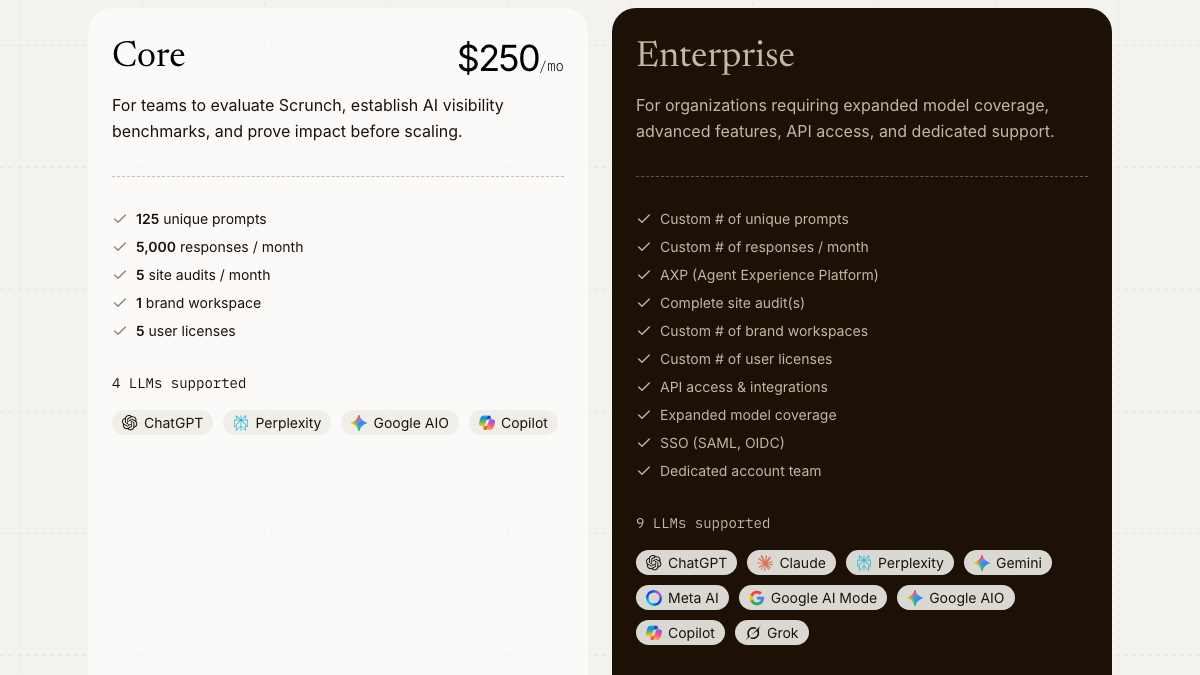
| Core plan | Limit |
|---|---|
| Unique prompts | 125 |
| Responses collected a month | 5,000 |
| Site audits a month | 5 |
| Site map | 25 pages |
| Page optimizations a month | 1 |
| Content generation | Basic |
| Brand workspaces | 1 |
| Seats | 5, then $25 each or $75 for five |
| Countries, languages, personas | 1 each |
The number to watch is responses, not prompts. OrganikPI bought the plan and ran a test brand through it. The reviewer found that the app counts responses, so 125 prompts only fits if each one runs on four engines, in one language, for one persona and one country.
Add a second persona and the same prompts need twice the responses. Scrunch's page lists both numbers side by side, but it doesn't say how they connect. I call it the answer-count test. Ask any vendor how many answers a month the price pays for. Our price per tracked question comparison runs that test on ten tools.
Scrunch's pricing FAQ, read on November 12, 2026, says standard plans support a single brand, and more brands mean an upgrade to Enterprise. Annual discounts are listed for Enterprise clients only.
The price has moved, too. A January 2026 review on GrowthPact described a $100 plan with 100 prompts for one user. Today's page shows $250 with five seats. Older write-ups quote plan names the page no longer shows, so read the live page and not the review.
The engines you pay extra to see
The engine list is where Core feels tight. ChatGPT, Perplexity, Google AI Overviews and Copilot come with the plan. Five more wait on Enterprise, Claude, Gemini and Google AI Mode among them.
OrganikPI noticed something small and a little annoying. The home dashboard's platform filter lists all nine engines, including the ones a Core account can't collect. If your buyers ask Gemini or Google AI Mode, a Core dashboard can't show you those answers.
RankControl checks seven engines on the one plan. That list includes Claude, Gemini, Grok and both Google surfaces, so a $400 plan never has a greyed-out engine to upgrade into.
Writing the pages
Scrunch announced Content Generation on November 4, two days before I read its pages. It finds topics that no page on your site answers, drafts a page, scores it and keeps the best version. Scrunch's post says publishing is always human-approved, and you copy or download the draft as HTML or Markdown.
Capacity is limited on every plan, according to the same post, and extra pages are an upgrade. On Core, the pricing table calls it basic and lists one page optimization a month. That makes it a feature to try, and not a publishing schedule.
RankControl's content engine plans titles from the questions your buyers search and writes up to 100 pages a month. Each article goes out as a native post through the destination you connect, and auto-publish stays off until you turn it on. We also draft the link outreach, which you send from your own mailbox.
Links are the other half of getting found, and Scrunch's pricing page doesn't list any outreach. RankControl finds prospects for each published article and drafts the emails, which go out from your own mailbox. If you'd rather hand the work off, Managed Backlinks is a separate $350 a month for five links from sites rated DR 25 or higher.
Scrunch grounds its drafts in documents you upload to a library it calls Knowledge Studio. RankControl builds a brand profile from your live site at setup, and you correct what's wrong. Both routes get you on-brand drafts. With Scrunch, the next step is yours, which is getting the draft into your CMS.
Tracking, in plain terms
Our AI visibility tracking checks 50 buyer questions on seven engines every week, which comes to 350 readings. You see which engines named you, where a competitor got named instead, and which sources the answers drew from. The weekly report adds your Google and Bing positions and the visits that came from AI answers.
Scrunch reports brand presence, position, sentiment and citations as percentages over time, according to its FAQ. It reads AI crawler hits from your server logs through a CDN or a plugin. Someone with access to the infrastructure has to wire that in, which OrganikPI noted in its review.
OrganikPI also watched the numbers settle. A test brand's mention rate moved from 84.4% to 87.1% between day one and day three, and its citation rate barely shifted. Whatever the vendor, a first-week number is soft, so judge a tool on the trend over several weeks.
Read the prompts before the score
Two reviews of Scrunch make the same point from opposite sides. GrowthPact's January review found that the prompts Scrunch generated came out too branded, like a "best product like yours" question where your name shows up by default.
OrganikPI's August test found the reverse. Scrunch wrote five of the test brand's fifteen prompts, and they reached into categories where that brand loses. The brand appeared in about two thirds of the answers to those five and in nearly every answer to the ten the reviewer wrote.
GrowthPact ended up writing its own prompts. OrganikPI's advice was to read the generated ones before trusting the score. Either way, the first hour belongs in the prompt list, and that goes for RankControl too. Our tracked queries come from the questions buyers actually search, and you can edit the list, so spend your first hour in it.
Trials, and the 14-day catch
Both products give you seven days and both ask for a card first. Scrunch's FAQ says the trial covers the full Core plan and that you're upgraded automatically unless you cancel. RankControl charges $0 today and the plan starts when the trial ends.
The catch with Scrunch is timing. Its FAQ says new prompts are collected daily for the first 14 days and every 72 hours after that. OrganikPI reported that Prompt Optimization needs 14 days of data, and the trial runs seven, so the card gets charged before you can judge it.
Setup runs on different clocks as well. Scrunch's FAQ says you enter your site, it generates competitors, personas and topics, and you paste in keywords or upload a CSV. It says smaller teams can read data within 20 to 60 minutes.
RankControl's setup reads your live site and drafts your brand profile, products, buyers and competitors, and you correct what's wrong. The trial step comes last. We check weekly, so the readings come slower, and the drafted titles are what you review first.
A fair test uses the same 20 questions on both. Pull them from sales calls, support tickets and the Search Console queries that bring people to your pricing page. Then compare what each trial left behind. One leaves a week of dense readings on four engines. The other leaves drafted articles and a baseline on seven.
AI search traffic grew 835% this year. Is your content ready?
RankControl generates 26 content formats optimized for ChatGPT, Claude, and Perplexity. Published on your domain, matched to your brand.

Support and onboarding
On Core, support is email and onboarding is self-serve, per the pricing table. Enterprise adds a dedicated account team, Slack and strategy calls, and Scrunch's Enterprise page describes a forward deployed engineer who configures your workspace. That's real hand-holding, and it comes with the quote.
RankControl has one plan and one level of help. Priority support is by email, with no Slack channel and no calls, and the in-app setup is meant to run without anyone from our side.
What people say
Real user chatter about Scrunch is thin. The Reddit threads with its name in the title sit in small subreddits and read like marketing posts. The most useful comment I found, in an r/Agentic_SEO thread about brand-mention tools, said the 7-day trial won the writer over and that Scrunch isn't for scrappy budgets, though you get what you pay for.
On G2, the pros-and-cons summary Google shows for Scrunch points at pricing and a wish for a lighter plan for individuals. That fits the price history above. On X, Scrunch mostly turns up in roundups, and Semrush's own account lists it in two of them.
When Scrunch fits better
Scrunch fits better for a team at a large site with an analyst and an IT team. It collects every prompt every 72 hours after the first fortnight, offers query fan-out views, and on Enterprise adds nine engines, SSO, API access and Agent Pages. Source for each is Scrunch's pricing page and FAQs, read on November 6, 2026.
What this costs by hand
Running 50 buyer questions through seven engines is 350 checks a week, or about five to six hours of copying answers into a spreadsheet. Writing and publishing even eight articles a month adds 30 to 40 hours before any outreach.
A $250 measurement tool still leaves you paying a writer, or yourself, for every page its report says is missing. The $400 plan includes that work.
Which one to pick
For a small team that needs articles live on Google and in AI answers, pick RankControl. We plan from your buyers' questions, write and publish on your domain, draft the outreach and check seven engines every week. In the first month you get a title calendar, articles going live on your schedule and four weekly readings of where you stand.
For a team that already has the pages and wants measurement and edge delivery in an enterprise stack, the section above says where Scrunch pulls ahead. Anyone between those two should run the 20-question test from the trial section and see which week-one result they'd rather have. If you've already decided to leave, our guide to switching from Scrunch covers what to export first and when to cancel.
You can do all of this manually. Or RankControl's agents can do it for you, every month, while you focus on your product. Want to see where you stand first? Run a free check of your brand in AI answers.

Built by the team that got cited in 48 hours.
Content generation, backlink building, AI visibility tracking, and Google rankings. One platform, zero guesswork.