You're six weeks from launch, there's no marketer on the team yet, and every SEO guide you open assumes you have one. One says publish three blog posts a week. Another says build 50 backlinks. A third says none of it matters because AI answers take the clicks now.
None of those is wrong for every company. They're wrong for the stage you're at. Startup SEO works best in stages, with a clear gate before each one: things to do now, things to skip until later, and a signal that tells you it's time to move on. This guide covers what to do before launch, with your first customers and once you have traction, and how AI search changes each step.
The short version
| Stage | Do this | Skip this | Move on when |
|---|---|---|---|
| Before launch | Crawlable site, product and pricing pages, Search Console | Blogging for broad category terms | Your core pages are indexed |
| First customers | Pages for the exact questions buyers ask, comparisons, getting named elsewhere | Competing for your category's main keyword | You have 10 or more useful pages and first impressions |
| Traction | A steady publishing rhythm, original data, harder keywords, maybe a hire | Paying for guaranteed rankings | Keep going |
We call each "move on when" a stage gate. It stops you from doing traction-stage work, which is expensive and slow, before the basics are in place.
Before launch: make the site findable
At this stage there's no traffic to win, so the job is to make sure nothing blocks you later.
Start with the pages that describe the product: what it does, who it's for, pricing and how to get started. Make sure they load their text in the HTML your server sends. Most AI crawlers don't run JavaScript, so a price that only appears after scripts run is invisible to them.
We checked four well-known startups that launched between 2024 and 2026: Cursor, Clay, Lovable and Attio. Three served their prices in the page HTML. Lovable's pricing page named its plans but didn't include a single price in the HTML, because the numbers load with JavaScript. An AI crawler reading that page would learn the plan names and nothing about cost.
While you're writing those pages, settle on one way to describe the company. Use the same product name, the same one-sentence summary of what it does and the same category words on your homepage, pricing page, social profiles and any directory listings. AI answers piece together a description of you from all of those places, and a startup that calls itself three different things makes that harder.
Then set up the free tools. Add your site to Google Search Console and use its URL Inspection tool to check that your main pages are indexed. Set up Bing Webmaster Tools too, since Microsoft's search feeds Copilot. Check your robots.txt: OpenAI says its OAI-SearchBot crawler "is used to surface websites in search results in ChatGPT's search features," so make sure you haven't blocked it by accident.
Skip the blog for now, at least for broad topics. Our guide to getting cited before launch covers what to seed instead, like directory listings and early community answers.
At launch and your first customers: answer the specific questions
Once people are signing up, you learn something no keyword tool can tell you: the exact questions buyers ask before they buy. Write them down from sales calls, support chats and onboarding. Those questions become your first pages.
Aim for pages with a clear job. A pricing page that explains who each plan fits. A comparison with the tool buyers ask about most. An integrations page. A few use-case pages for the customers you've already won. Our plan for a brand-new website covers the technical and content steps in more detail.
Don't skip the basics while you do it. On r/SEO, someone asked what to tackle first on a site, and the top answer was plain: title tags, broken links, sitemaps and internal linking.
In terms of SEO, what would you tackle first?
The thing to skip at this stage is your category's main keyword. When we looked at Google's AI Overviews for each of the four startups' category questions on September 27, 2026, none of them was cited. "Best ai code editor," "best crm for startups" and two others returned AI Overviews that cited Reddit threads, YouTube videos and other companies' roundups. Three of the four didn't rank in the top 20 for their category term at all.
These are successful, well-funded companies. If they aren't cited for the head term yet, a newer startup shouldn't expect to be. The early wins are in narrower questions, and in getting named inside other people's comparison posts and community threads.
That second part is work you can start now. Ask your first happy customers for reviews on the software directories buyers in your category read. Answer questions in the communities your buyers use, from your own account and with your affiliation stated. Pitch the writers of the roundups that already rank for your category, with something specific they'd want to add. Each mention is one more place an AI answer can find you.
15 hours a week manually. Or 15 minutes with RankControl.
Track citations, monitor competitors, and fix content gaps across every AI search engine. Automatically.

Once there's traction: build the engine
Traction changes the math. You have customers to learn from, a product that's stable enough to describe and, usually, some links and mentions you earned along the way. This is when a steady publishing rhythm starts to pay.
Expand in three directions. Publish for harder, broader keywords now that you have some authority. Turn what you know into original data, like benchmarks from your product or survey results from your customers, because pages with something new are what AI answers and journalists cite. And keep the pages from the first stage accurate as the product changes.
Measure as you go. Search Console's generative AI report shows impressions from Google's AI features by page, and a monthly check of your main buyer questions in ChatGPT and Perplexity shows whether you're being named. If a page ranks but never gets cited, that's the one to improve before you write the next.
This is also when a hire or outside help can make sense. Google's own advice on SEO providers says "a great time to hire is when you're considering a site redesign" or planning a new site, and adds that "if you run a small local business, you can probably do much of the work yourself." Its sharpest line is a warning: "If they guarantee you that their changes will give you first place in search results, find someone else."
Here's what that can look like. One indie founder posted in September 2026 that after ten years of products, the one that finally took off was growing fully organically on the back of SEO, heading toward 10,000 users:
I found my "one product" this year. > I have a co-founder > It's in a niche where users are ready to pay > We're killing it in SEO > We're now growing fully organically > We're about to reach 10K users It only took me 10 years and dozens of failed products to find the one https://t.co/inIS7KS2Ja
 Manoj Ahirwar@manoj_ahiSep 25, 2026

How long it takes
Set expectations early, especially with investors. Google's SEO Starter Guide answers the question directly:
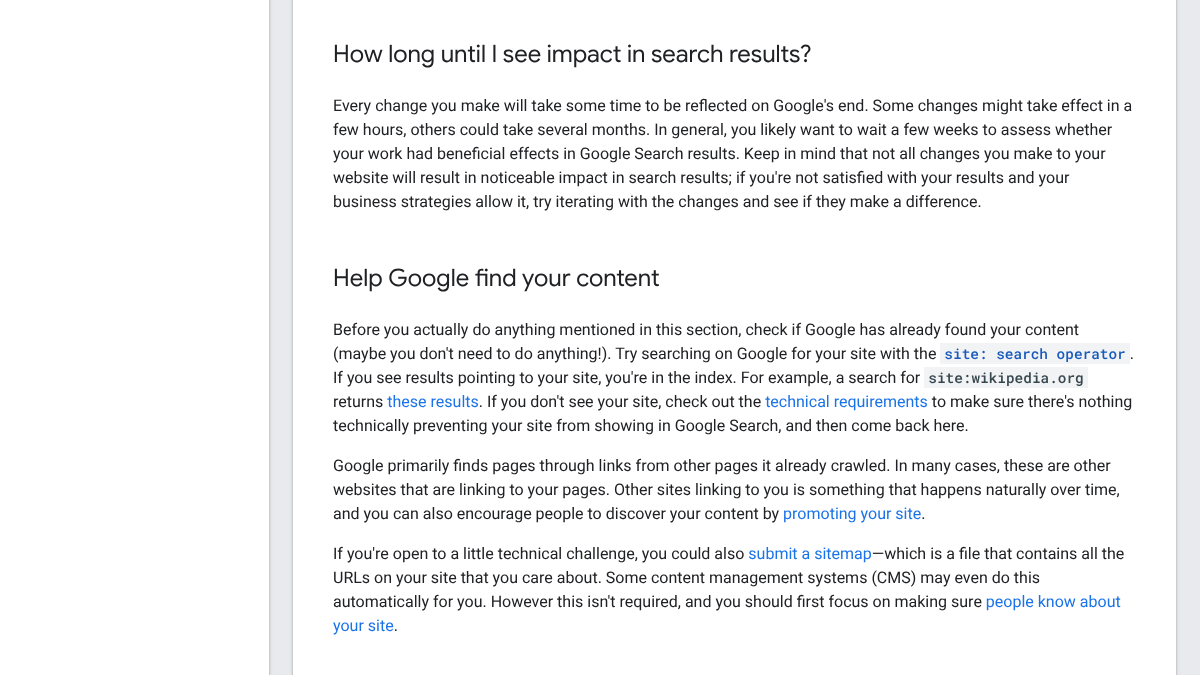
"Some changes might take effect in a few hours, others could take several months," it says, and suggests waiting "a few weeks to assess whether your work had beneficial effects."
For new pages competing on real keywords, the odds are long. In a study of a million random pages, Ahrefs found that only 1.74% reached Google's top 10 within a year. Most of the pages in the top 10 were more than three years old. That's why the first two stages focus on specific questions, where a new page can win, instead of broad terms where it mostly can't.
AI answers follow a different clock. In our 90-day look at new SaaS blog posts, Perplexity picked up most of the posts within one to three months, while ChatGPT cited none of them, because it mostly searches for pricing and product questions rather than blog topics.
AI search traffic grew 835% this year. Is your content ready?
RankControl generates 26 content formats optimized for ChatGPT, Claude, and Perplexity. Published on your domain, matched to your brand.

What to skip at every stage
Some things aren't worth a startup's time at any stage:
- Paid link packages. Google treats buying links for ranking as spam, and a new domain can't afford the risk.
- Bulk AI-generated pages. Google's spam policy covers generating many pages without adding value, however they're made.
- Special AI files. Google says its search doesn't need "new machine readable files, AI text files, markup, or Markdown" to appear in its AI features.
- Anyone who promises rankings by a date.
If you're not sure SEO is worth starting at all, our post on whether SEO is still worth it makes the case with the numbers.
Doing it yourself or handing it off
The first two stages are well within a founder's reach. The foundations take a few days, and the first ten pages take a few weeks alongside everything else. Checking whether AI answers cite you takes an hour a month by hand.
The traction stage is where the time adds up. RankControl's content engine writes each article against the pages already ranking for its keyword and publishes it on your own site. Our AI visibility tracking checks up to 50 buyer questions every week across seven AI engines and records every source each answer cited, including the roundups where competitors got named instead of you.

Built by the team that got cited in 48 hours.
Content generation, backlink building, AI visibility tracking, and Google rankings. One platform, zero guesswork.