
Search for Adobe LLM Optimizer today and Adobe's own documentation corrects you. LLM Optimizer has evolved into Adobe Brand Visibility, a name that arrived after Adobe closed its $1.9 billion purchase of Semrush on April 28, 2026. Plenty of reviews still use the old name, and the old metric names with it.
This page sets that product next to RankControl, for a team of one to five people with no Adobe license. Adobe's pages describe a platform for enterprise teams, with CDN rules, log forwarding and a business agreement, so the useful question is how much of that lands on you.
Everything about Adobe below comes from its Experience League docs and partner pages, which I read on November 6, 2026, or from a source I name. The comparison is RankControl vs Adobe LLM Optimizer, with the new name added where it matters.
The short answer
Pick RankControl if you're a small team without Adobe licenses and you want articles written, published and tracked. You sign up, pay one flat price, and a title calendar is waiting for your review in your first month. Adobe's way in is a contract, unless you already run Adobe Experience Manager Cloud or Adobe Analytics, and what it fixes is pages you already own.
| Adobe LLM Optimizer (Brand Visibility) | RankControl | |
|---|---|---|
| Price | Not published; licensed by contract | $400/mo or $4,000/yr, one plan |
| How you start | Trial for Adobe customers; others sign an agreement | Self-serve signup, 7-day trial, card up front, $0 today |
| Engines in the docs | ChatGPT, Google AI Overviews, Google AI Mode, Copilot, Gemini, Perplexity | ChatGPT, Perplexity, Claude, Gemini, Grok, Google AI Mode, Google AI Overviews |
| Tracked volume | Trial caps at 100 prompts and one domain | 50 queries, each on every engine |
| What it changes | Existing pages, through CDN edge delivery | Writes new pages, up to 100 a month |
| Setup | Crawler allowlist, log forwarding, edge routing rules | Connect your CMS |
| Publishing | Fixes go to your CDN or CMS | Native posts through 9 destinations |
| Team | Shared dashboards with assigned owners | 5 seats |
Checked on November 6, 2026 against Adobe's documentation and each vendor's pricing page.
What happened to the name
Adobe introduced LLM Optimizer in 2025. After the Semrush deal closed, Adobe's partner page describes Brand Visibility as the evolution of LLM Optimizer, joining Semrush's market demand and search signals with Adobe's optimization tools. It says feature enablement began on August 3, 2026.
| Date | What happened |
|---|---|
| June 2025 | Adobe introduces LLM Optimizer |
| April 28, 2026 | Adobe closes its $1.9 billion Semrush purchase |
| August 3, 2026 | Feature enablement for Brand Visibility begins |
Some metrics were renamed on the way, and one was redefined. Adobe's what's-new page lists them, and the table below has the short version.
| Old name | New name | What changed |
|---|---|---|
| Visibility Score | Brand Visibility | Mentions only; it used to blend in citations, position and sentiment |
| Popularity | Topic Volume | Real search demand, not high, medium or low |
| (none) | Source Visibility | How often your site is used as a source |
| Share of Voice | Share of Voice | Now weighted by search demand and ranking position |
So if a review you're reading talks about a Visibility Score, it was written before August. Adobe says the new number can look different when nothing about your presence moved, and that opportunities and deployments work the same as before. Keep that in mind before you line old screenshots up next to new ones.
How a small team gets in
Here's the door, as the Quick Start page describes it. Two groups of customers can try the product free. One runs AEM Cloud, and the other runs Adobe Analytics or Customer Journey Analytics. The page offers no trial to anyone else, and for them the first step is a business agreement. Once it's signed, Adobe sets up the domain you chose.
| Trial since April 1, 2026 | Limit |
|---|---|
| Prompts | 100 |
| Domains | One |
| URLs for optimizations | 50, for a single opportunity type |
| Trials started earlier | 200 prompts, under their old terms |
| Beyond these limits | A separate license agreement |
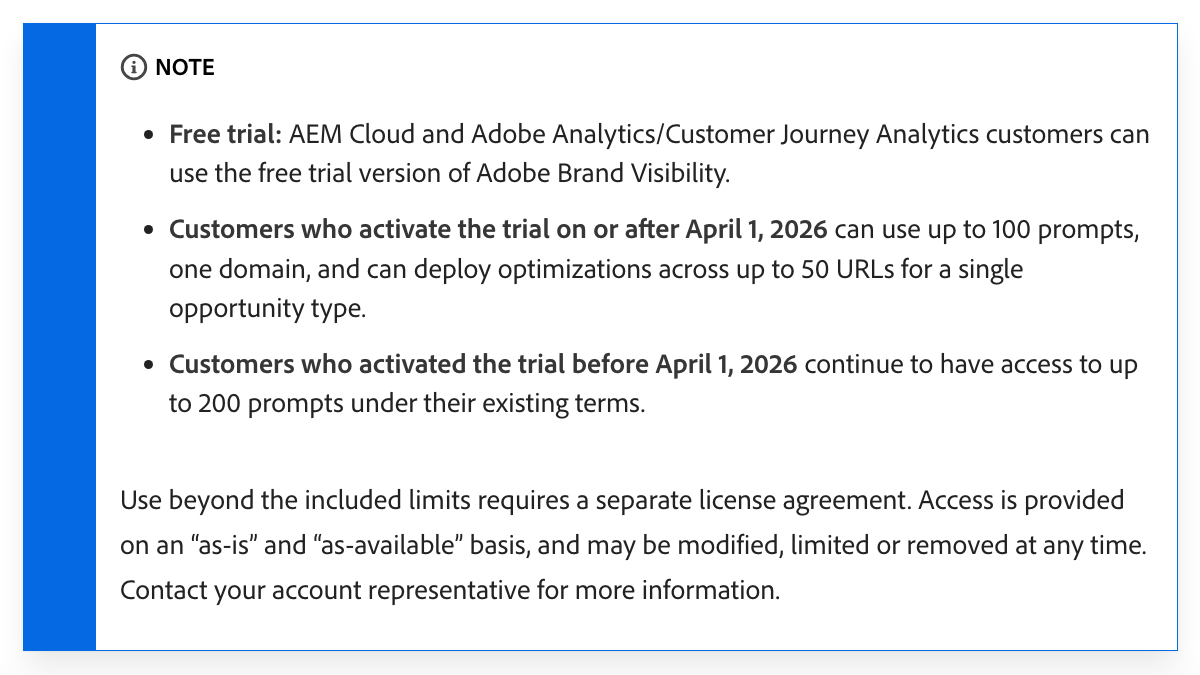
The same note adds that use beyond those limits needs a separate license agreement, and that access "may be modified, limited or removed at any time."
Adobe lists no price. I tried its product description page and got an access-denied error, so treat what follows as partner reports and not Adobe's word.
| Source | What it said |
|---|---|
| DWAO, an Adobe implementation partner (June 2026) | Annual contracts sized by prompt volume, a minimum of 1,000 prompts, steps of 200, no monthly card sign-up |
| AirOps (March 2026) | Packages start at a minimum of 1,000 prompts |
| Adobe | No price published |
DWAO, which implements Adobe products, wrote in June that licensing runs on annual contracts by prompt volume, with a minimum of 1,000 prompts and steps of 200. AirOps reported the same minimum. A floor like that suits a company with many products and markets. A team with one product and one market usually has a few dozen questions that matter.
Small teams do have one free way in. Adobe's docs describe an LLM visibility checker, a Chrome extension that needs no license or setup. It shows what AI agents can see on a page next to what a person sees, and Adobe says it estimates how much hidden content its platform could recover.
It makes a good first test. Open the five pages that earn you the most traffic and compare the two views. If they match, edge delivery has little to fix on your site, and your money is better spent on pages that don't exist yet. If big blocks are missing, usually because they load through JavaScript, you've found the one job Adobe's edge delivery is built for.
15 hours a week manually. Or 15 minutes with RankControl.
Track citations, monitor competitors, and fix content gaps across every AI search engine. Automatically.

What setup asks of your IT team
Picture the ticket your IT person gets. Before Brand Visibility can read your site, Adobe asks you to allow its crawler, which identifies itself as Spacecat/1.0. The Quick Start page lists five single IP addresses and 17 address ranges to allowlist in your CDN, firewall or bot rules. It also asks you to forward CDN logs if you want traffic data, and it has setup guides for the common CDNs, Akamai and Cloudflare among them.
Edge delivery adds more. Adobe's Optimize at Edge page says an admin must add routing rules at the outer CDN and allow a second user agent, AdobeEdgeOptimize/1.0. Only AEM Cloud customers on managed Fastly can finish that setup inside Adobe's own interface. Everyone else hands the steps to a CDN team.
| Step | What Adobe asks | Who does it |
|---|---|---|
| Let the crawler in | Allow the user agent Spacecat/1.0 and five single IP addresses plus 17 ranges | Admin or IT |
| Forward CDN logs | Needed for traffic data; guides cover the common CDNs | IT |
| Route traffic at the edge | Rules at the outer CDN | IT, unless you run AEM Cloud on managed Fastly |
| Allow a second user agent | AdobeEdgeOptimize/1.0, in bot and firewall rules | IT |
| Pick the domain | Shared by everyone in your organization, and it can't be changed later | Admin |
| Start with a brand | Each organization starts with one active brand | Admin |
Adobe's overview page names three kinds of user, marketing managers, SEO analysts, and PR and communications managers. On a team of two, that's one person wearing three hats.
If you can't edit your CDN rules, ask Adobe before you buy. A team on a hosted website builder may be in that spot. I couldn't find a page that says what the edge features do without those rules.
What Adobe fixes, and what it doesn't write
The opportunities dashboard is a list of fixes for pages you already have. On the page itself, Adobe's docs flag missing summaries, missing FAQs and media with no transcript, plus dense copy and missing tables of contents. Other checks look for crawlers blocked in robots.txt and content hidden behind JavaScript. A separate group reports on what Wikipedia, YouTube and Reddit say about you.
Most of the on-page checks apply to "high-traffic pages," in Adobe's words. A site with 30 pages and modest traffic has fewer of those to fix. For a team like that, the bigger gap is usually the page nobody has written, and Adobe's docs don't describe an article writer.
The delivery method is the unusual part. Optimize at Edge serves changed HTML only to AI agents, and Adobe says human visitors and SEO bots don't see it. Adobe's September 25 docs call edge-based auto-optimization an early-access feature for select opportunities.
Adobe also measures its own fixes. Its Impact Measurement Engine creates custom prompts for each URL you change, sets a baseline, and re-runs the same prompts afterward. Adobe says a reading takes about two weeks, so don't expect quick answers.
That design matters for Google. Google's own guide, updated July 10, 2026, says you don't need to rewrite content just for AI systems, and that unique, people-first content does the most for Google's AI features. Edge delivery is aimed at the other agents, so the pages Google ranks stay as they were. You can read the Google guide yourself.
RankControl works from the other end. Our content engine plans titles from the questions your buyers search and writes up to 100 pages a month. Each one is published as a native post, so the content lives at a normal address on your own domain.
AI search traffic grew 835% this year. Is your content ready?
RankControl generates 26 content formats optimized for ChatGPT, Claude, and Perplexity. Published on your domain, matched to your brand.

Two layers of measurement
Adobe's docs split tracking into two layers, and the split explains some of the confusion in reviews. One layer describes a market. The other measures the list you chose.
| Layer | Where the data comes from | Engines | Setup |
|---|---|---|---|
| AI Visibility | Semrush's shared database of more than 289 million prompts | Four: ChatGPT, Google AI Overviews, Google AI Mode, Gemini | None |
| Brand Presence | The prompts you choose, run on a recurring schedule | Six: ChatGPT, Google AI Overviews, Google AI Mode, Copilot, Gemini, Perplexity | You pick the prompts |
Prompt Management draws suggestions from Semrush, your Google Search Console data, synthetic personas and pages where you want citations. Our weekly checks measure only your list, which is 50 questions you can edit, on seven engines.
Week one for a two-person team
With Adobe, someone signs in with an Adobe ID that has an entitlement, then enters a brand name and domain. Adobe generates a small set of categories, topics and prompts, and brand-presence data shows up shortly after. Traffic data and edge fixes wait on the allowlist, the log forwarding and the CDN rules, which means a ticket for IT.
With RankControl, you sign up and our setup reads your live site. It drafts your brand profile, products, buyers and competitors, and you correct what it got wrong. The trial step is last. After that, our AI visibility tracking checks 50 buyer questions on seven engines every week, and drafted titles wait in your calendar for approval.
We ask for something too. You connect a publishing destination, and a WordPress site installs our plugin. Auto-publish is off until you switch it on, so the first article you see is a draft you can read and edit. Nobody has to open a CDN ticket.
Neither week is effortless. One asks for an IT ticket, and the other asks you to read drafts.
A partner who has configured the product for a few dozen clients wrote one tip on Reddit that fits both tools. Pick your prompts early and leave them alone, because changing the list every few weeks makes it impossible to tell whether visibility moved or you did. The same holds for our 50 queries.
What people say
Public talk about Adobe LLM Optimizer is thin, and much of it comes from people who sell the setup. A commenter in r/SEMrush opened by saying they founded and run an Adobe solution partner, then praised one-click deployment after more than 20 client configurations. The r/AdobeBrandVisibility post I found came from a partner with a few dozen clients, and the pricing explainer cited above came from DWAO, another implementation shop.
These are informed people. They also earn a living on implementation, which tells you how much hand-holding the product expects.
An independent voice turned up in r/aem, in a March thread about testing the product. The writer singled out Adobe's edge optimization for client-side-rendered AEM and Edge Delivery sites, and the few replies were friendly. On X, most posts that mention the product are about Adobe's stock. The most relevant one was an August announcement of a Stack Overflow podcast with an Adobe engineering director, who was set to discuss the Semrush deal and a three-day internal hackathon.
When Adobe fits better
Adobe fits better for a company already on AEM Cloud or Adobe Analytics with a CDN team and many brands or markets. Its trial is built for those customers, and its AI Visibility view starts from Semrush's database of more than 289 million prompts, with nothing to set up. Source is Adobe's Experience League docs, Quick Start updated November 3 and AI Visibility updated September 4, 2026.
What this costs by hand
| Chore | Time |
|---|---|
| Checking 50 buyer questions on seven engines each week | 350 checks, about five to six hours of copying answers into a spreadsheet |
| Writing and publishing eight articles a month | 30 to 40 hours before any outreach |
Adobe's contract pays for measuring and fixing, and the hours above are still yours. The $400 plan takes on the writing and the publishing. The weekly readings land beside the drafts in one report.
Which one to pick
Pick RankControl if your team is one to five people and nobody holds an Adobe license. You can start without a contract, a CDN ticket or a sales call, and what you pay for is articles on your own domain. We also check seven engines weekly and draft link outreach from your mailbox.
Already running Adobe's stack and want fixes pushed to the edge? The section above says where Adobe pulls ahead. For the Semrush half of Brand Visibility, read our comparison of Semrush Enterprise AIO. For the same question about a different enterprise product, see Profound for small marketing teams.
You can do all of this manually. Or RankControl's agents can do it for you, every month, while you focus on your product. Want to see where you stand first? Run a free check of your brand in AI answers.

Built by the team that got cited in 48 hours.
Content generation, backlink building, AI visibility tracking, and Google rankings. One platform, zero guesswork.