
Last week I went through my product launch inbox and counted the AI visibility and AEO announcements from May, June and early July 2026. There were eight, or nine if you count Peec opening its New York office as a launch event. Ahrefs and Semrush were in the pile, and so were HubSpot and Meltwater. Otterly, Profound, Similarweb and Conductor rounded it out.
I can't name a company in the enterprise SEO tool space that isn't shipping AEO features right now. It's a land-grab for the whole category, in real time. When every major player in a category ships the same kind of feature inside one 90-day window, the market is telling you something specific. Most of what shipped is measurement, though, and measurement alone doesn't solve the citation-share problem.
Below is what each of the eight launched and why they all landed together, then the gap every one of them still leaves.
The Q2 2026 AEO tool launch wave
Dates, entry prices and target buyers are in the table, and under it is what I make of each product.
| Tool | What shipped, and when | Entry price | Built for |
|---|---|---|---|
| Ahrefs Brand Radar | YouTube, TikTok and Reddit citation tracking through Q2 2026, after January's custom AI prompt tracking | $199/mo per platform index or $699/mo bundle, on top of the $129/mo Ahrefs base (~$828/mo) | Enterprise SEO teams already on Ahrefs |
| Semrush Enterprise AIO | Announced May 27 with Unified Content Optimization | Enterprise custom; standalone AI Visibility Toolkit $99/mo | Enterprise and agency |
| Meltwater GenAI Lens | 2026 Mid-Year Release in May: Audience Insights for AI Search, Google Analytics integration | Enterprise custom, no public pricing | Enterprise PR/comms |
| Otterly.AI | Public API, Claude Skill and 101+ workflow Marketplace, all on June 1, 2026 | From $29/mo | SMB/agency, early-stage startups |
| Profound Agents | GA after a $96M Series C at a $1B valuation on February 24, 2026 | $499/mo entry (reviews: $99/mo Starter funnels to $399/mo Growth) | Enterprise ($50M+ ARR) |
| Conductor AgentStack | Launched April 2026 | Enterprise custom | Existing Conductor contract holders |
| Similarweb Gen AI Intelligence Toolkit | Rolled through Q2, after the March 3, 2026 Generative AI Brand Visibility Index | Enterprise custom | Enterprise research/strategy teams |
| Peec.AI | New York office in Q2 2026, hiring 40+, after a $21M Series A | €89/mo | Mid-market B2B SaaS ($5M-$30M ARR) |
| HubSpot AEO | Launched at the Spring 2026 Spotlight, built on the acquired XFunnel | Bundled in Marketing Hub tiers | HubSpot Marketing Hub customers |
Ahrefs is the data-heavy option. Brand Radar runs on a database of more than 260M prompts, with visibility for ChatGPT, Perplexity and AI Overviews, and on May 26 Ahrefs published a study correlating YouTube mentions with AI Overview citations. It still doesn't track Claude, Grok or Meta AI, and users have reported accuracy gaps in the ChatGPT and Perplexity numbers.
Glenn Gabe covered the schema and citation research behind that study when Ahrefs shipped it:
Interested in Schema impact on AI citations? Here's the latest study from @ahrefs -> We Tracked 1,885 Pages Adding Schema. AI Citations Barely Moved "We tracked 1,885 web pages that added JSON-LD schema between August 2025 and March 2026, matched them against 4,000 control https://t.co/y40FL9e7Dy
 Glenn Gabe@glenngabeMay 11, 2026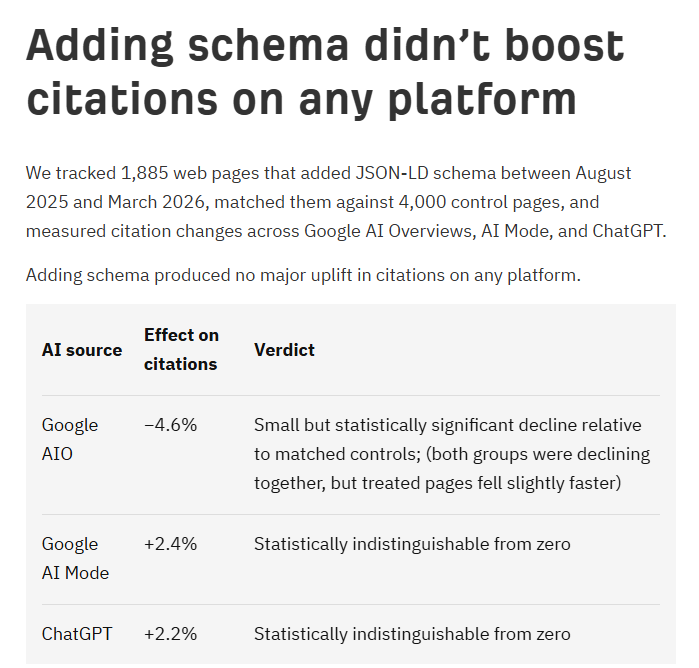
Semrush built Enterprise AIO to merge SEO and AI optimization workflows. The main pieces are Visibility Overview, Prompt Research, Brand Performance and an AI Search Site Audit. Forecasting sits on top, and Adobe now sells it through business.adobe.com. User reviews say the $99 tier produces "thin reports for smaller domains," and Semrush hasn't shipped a content-generation layer inside AIO itself.
Three platforms is a thin start for HubSpot. Its AEO tracks brand appearance in ChatGPT (GPT-5.2), Perplexity and Gemini, with no Claude and no Copilot at launch, and HubSpot claims 1,850% growth in AI-sourced leads from internal testing. The whole product assumes you're staying inside the HubSpot ecosystem.
Practitioners who've reviewed Meltwater say its LLM coverage feels "bolted on" to the legacy social listening infrastructure, which fits a company that came at AEO from the PR side. The release gives GenAI Lens 24-48hr custom prompt runs across ChatGPT, Gemini, Perplexity and Claude. The Mira AI Companion and speech-to-text arrived with it. Positioning it for PR and comms teams also means it misses the buyer who wants AEO tied into SEO.
Conductor's AgentStack is a suite of native LLM apps and turnkey agents for AI visibility, including a native ChatGPT app, LLM developer infrastructure and agent-based content workflows. Charter, Airbnb, Coca-Cola and Atlassian came on as customers in FY26. It's locked to Conductor's existing enterprise contract structure, though, and the entry cost is prohibitive for anyone under $10M ARR.
Similarweb's weakness is its sample. The toolkit tracks mention share across ChatGPT, Gemini, Copilot and Perplexity and ties AI recommendations to actual traffic, but with 11K prompts in Finance it ends up heavy on benchmarks and light on tactical output for your own brand.
Profound is the startup the incumbents are reacting to. Lightspeed led its $96M round, and the Agents are pitched as autonomous workers that execute AEO tasks on a 260M-prompt dataset. Target, Walmart, Figma and Chime are named customers. Critics call the pricing structure an intentional up-sell funnel, and smaller SaaS teams find the Starter tier too limited to act on.
Otterly and Peec are the small monitoring tools, and both stop at monitoring. Otterly's June release adds programmatic access to brand reports and citations, a Zapier integration and community-submitted workflows, but you still fix the gaps somewhere else. Peec, which is hiring across product, engineering and CS, tracks share of voice and citation rate across LLMs. Its founders do support directly in Slack, and practitioner reviews say it has no content generation and no opportunity surfacing.
Lily Ray pointed at one slice of the Brand Radar data in particular, the growth in Reddit citations inside AI Overviews:
Think Google is leaning on Reddit more heavily in AI Overviews for "best" keywords The chart below is Reddit citations in AI Overviews via @ahrefs Brand Radar filtered for prompts containing "Best" https://t.co/S8yp7wTzpu
 Lily Ray 😏@lilyraynycJun 8, 2026
That's the signal behind every launch above. The citation surface is where enterprise buyers now demand visibility, and an enterprise tool that doesn't ship the feature loses share.
You're getting AI traffic. But do you know where it comes from?
RankControl credits every visit to the assistant that sent it: ChatGPT, Perplexity, Claude, Gemini, Copilot, or Grok. Full source attribution, next to your Google traffic.
Why they all launched at once
Three forces squeezed the launch calendar, and the first was plain demand. Google's Q1 2026 earnings confirmed more than 2 billion AI Overviews users, and enterprise buyers who had been happy to defer AI visibility tracking to Q3 or Q4 2026 wanted it immediately. Any enterprise SEO director asking the CMO for Q3 budget had to bring an AEO tool proposal, so every enterprise SEO tool needed an AEO product to sell.
ChatGPT's 900M weekly active users and Gemini's 900M MAU pointed the same way. The two look identical, but a weekly count is harder to reach, so ChatGPT's is the stronger number.
The second force was supply. Citation tracking has to cover ChatGPT, Gemini, Perplexity and Claude. Google's AI Mode and AI Overviews count too. Covering all of them takes prompt sampling infrastructure and LLM interaction pipelines, and then you need canonical URL resolution, brand normalization and de-duplication logic on top. Ahrefs, Semrush and Similarweb had been building this quietly for 12-18 months. By Q2 2026 the data quality was defensible enough to productize, and they shipped as soon as the infrastructure was ready.
The third force was the trigger: Profound's $96M Series C at a $1B valuation in February 2026. I think of it as a two-quarter clock, because once a category-defining startup raises at that scale, every incumbent has to ship a competing product within the following two quarters or lose the category narrative. Profound raised in February, and by May through July every major enterprise SEO and marketing tool had a competing AEO surface.
Anyone who's watched a software category form will recognize the pattern. Standalone startups define the category first, and here that's Profound, Peec and Otterly. Then incumbent platforms bolt on competing features to defend the enterprise contracts they already hold. That second group is Ahrefs, Semrush and HubSpot, and Meltwater, Similarweb and Conductor are in it too. We're in the middle of the second wave, and Q3 will decide which tools become the durable enterprise standard.
The specific gap every tool leaves
My read is that almost every one of these launches is a monitoring dashboard. You see which prompts you're missing and who's cited instead, along with your share of voice and your freshness gap, and then the tool basically stops.
The gap is content generation. More precisely, it's the workflow that connects "you're missing this specific prompt" to a page structured to be cited for it, published on your domain within the week, and none of the eight ships that workflow natively.
Ahrefs Brand Radar tells you your ChatGPT citation gap is [industry-specific query]. It doesn't ship the page that maps to that gap, with a descriptive URL, semantic-triple phrasing, the answer in the first 30% and current freshness signals.
In Semrush Enterprise AIO, the Visibility Overview shows your competitors' citation share and Prompt Research shows which prompts they're winning. The "then what?" of writing and shipping the page that closes the gap is left as an exercise for your content team.
Profound Agents come closest, since Profound claims they're "autonomous workers." In the current product, though, the autonomous workflow looks more like research summarization plus dashboard automation than full content generation and publishing.
HubSpot owns both halves. HubSpot AEO tracks appearance across three platforms and Marketing Hub can generate content through the HubSpot AI Content Assistant, but the two surfaces aren't tightly integrated. Going from the AEO gap to a shipped, AEO-optimized page means crossing a workflow boundary most users don't cross well.
So enterprise buyers who put $800-$5000/mo into monitoring either run a separate content operation (an SEO agency, writers, an in-house team) to close the gaps it surfaces, or they accept that the monitoring itself is the deliverable. Neither is what they wanted when they bought the tool. Our piece on dashboards versus pipelines in AI search makes the longer case, including when a dashboard alone is enough.
Why this gap matters
The gap bothers me because the tactical loop behind it is simple, and there's no reason to leave it open. It has five steps:
- Find a prompt where you should be cited and aren't.
- Draft a page structured to be cited for that prompt, with a descriptive URL, a semantic-triple opening, the answer in the first 30% and current freshness.
- Publish it, seed it and refresh it.
- Track whether your citation share on that prompt moves.
- Repeat every week.
Step 1 is what every monitoring tool covers well. Steps 2 through 5 are what none of them ship as a single native workflow, so the enterprise buyer who wanted "solve my AI visibility problem" got "measure my AI visibility problem, then hire someone to solve it." That's a real product-market fit gap.
The tools that eventually consolidate the category will be the ones that ship the full loop, with monitoring, generation, publishing and tracking inside one system and one coherent workflow. None of the eight Q2 2026 launches ships that natively. Profound Agents is the most vertically integrated attempt and HubSpot has content generation elsewhere in its platform, but across the board the gap is still there.
We'll show you exactly where your brand stands in AI search.
No commitment. $0 due today, cancel anytime. See how ChatGPT, Perplexity, Claude, Gemini, Grok, and Google AI Mode talk about your brand today.
What this means for a SaaS buyer
If you're evaluating AEO tools this quarter, start from the stack you already pay for, since most of these products were built to extend one.
Teams deeply invested in Ahrefs should look at Brand Radar first. It has the most defensible data pipeline here, with best-in-class breadth across ChatGPT, Perplexity and AI Overviews. YouTube, TikTok and Reddit are covered too. Budget $828/mo at entry, and expect strong measurement plus a continuing need for a content ops team.
A Semrush team gets unified content-optimization workflows alongside AEO tracking in Enterprise AIO, at enterprise custom pricing. The content-workflow integration is better than Ahrefs', but the layer that actually generates content is thin. HubSpot AEO makes sense if you're already deep in Marketing Hub and value the content-generation integration through Content Assistant, even with the tracking limited to 3 platforms. The bundled pricing is its killer feature.
Profound is for enterprises at $50M+ ARR that want the highest-signal share-of-voice data and can live with the up-sell pricing structure: $499/mo at entry, and expect to graduate to the $399/mo Growth tier or higher. Similarweb Gen AI Intelligence gives you enterprise-grade benchmarking against category peers at enterprise custom pricing, as long as you accept the sample-based methodology.
Conductor AgentStack only makes sense for existing Conductor enterprise customers, because for everyone else the entry point is prohibitive. Meltwater fits when PR and comms are the primary use case and you want AEO tracking layered into your existing social listening workflow, again at enterprise custom pricing.
Smaller teams have two good fits. Peec.AI at €89/mo suits mid-market B2B SaaS in the $5-30M ARR range, if you want direct-Slack founder support and you're comfortable with monitoring only. Below $5M ARR, when $29/mo is the constraint and you want programmatic API access, Otterly.AI is the one, and basic monitoring is fine at that stage until you graduate.
None of these is a wrong choice, since each fits a specific buyer profile, but every buyer should be clear that they're getting a measurement layer and not a full solve of the AEO problem.
The broader read
Put together, the Q2 2026 AEO tool wave is a real category-emergence event. Eight enterprise-scale tools launching competing features within 90 days isn't something that happens in niche categories. Enterprise buyers are voting with budget, and the category is coalescing into a durable multi-billion-dollar market.
I expect the gap between measurement and action to get closed in the next 12-18 months, and the closing move will decide which tool becomes the durable category leader in 2027. Profound could expand Agents into full generation. HubSpot could tighten the workflow from AEO to Content Assistant, or Semrush could ship generation inside AIO. It could also be a new entrant with the full loop from day one, or RankControl (yes, this is our positioning).
Our content engine ships the work the monitoring tools tell you to do and then leave to you. Articles get planned from buyer questions, written answer-first and published to your CMS. Outreach is drafted for each one, and citations are tracked weekly across six engines, all inside a single workflow. That's the specific gap we chose to close.
The measurement wave is real, and I think the action wave comes next. If you're already invested in Ahrefs or Semrush for measurement, you can add our content engine as the action layer, and if you want one product to do the whole job, that's what we do. Either way, whoever closes this gap first at scale gets the category, and in H2 2026 the market still hasn't closed it.
For the full strategic frame, see The 2026 State of AI Search: RankControl's Annual Report. Weekly visibility tracking across six engines is what our AI visibility surface covers, integrated with the content engine that closes the loop.
One more frame
The way I read it, the Q2 2026 wave settles whether AEO is a real category, and it is. There are eight enterprise-scale tools launching competing features in 90 days and a $96M Series C at a $1B valuation for the leading standalone startup. Add Google's Q1 numbers confirming 2B+ AIO users and the Chartbeat data on publisher traffic being redistributed, and every piece of the market structure says AEO is a durable multi-billion-dollar category with expanding buyer demand.
That reframes the buying decision. Whether to invest in AEO tooling this quarter is already answered, so the question is which tool you'll standardize on for the next 2-3 years. Switching costs are meaningful here (data pipeline integration, historical benchmarks, rewiring how the team works), which makes it worth getting right. These are the criteria I expect to matter most in 2027.
Start with data quality and freshness. Does the tool check citations on a fixed schedule, at least weekly, and does it dedupe correctly across engine variants? At minimum it should cover ChatGPT, Gemini, Perplexity and Claude. On Google's side it needs AI Mode and AI Overviews.
Next is workflow integration: does it connect measurement to action, and if not, does it integrate with the tools that do?
Cost per meaningful prompt tracked is the one I'd watch through the year. An enterprise tool charging $800/mo for 100 tracked prompts won't be defensible in 2027, when startups ship the same thing at $99/mo, so expect pricing pressure.
The last criterion is vertical depth. Tools with strong per-vertical benchmarks in SaaS, healthcare, e-commerce or finance will beat generalist tools for buyers with a specific focus.
The eight Q2 launches differ meaningfully on all four. Buyers who pick right in Q3 will look prescient in 2027. The ones who pick on brand alone (Ahrefs, Semrush, HubSpot) will end up with adequate measurement and still need to hire someone to close the action gap, while buyers who pick on the close-the-full-loop criteria end up with tools that do more of the work end to end.
Know exactly what AI says about your competitors.
RankControl's Recon Agent monitors competitor citations across ChatGPT, Perplexity, Claude, Gemini, Grok, and Google AI Mode. See where they show up and you don't.