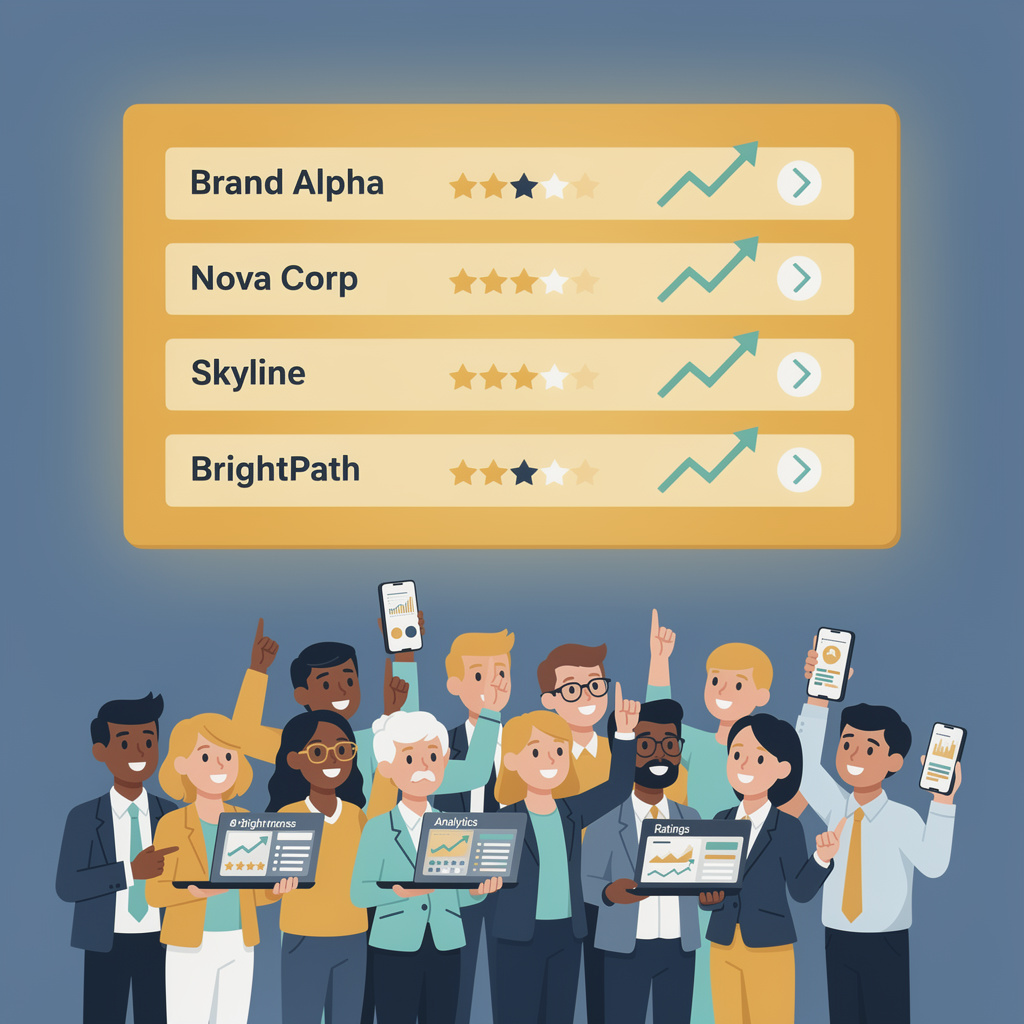
Somewhere today, a buyer opened ChatGPT and typed "best tools for [your category]." The model gave them a confident, ranked shortlist. It named three of your competitors, explained why each was a solid pick, and never mentioned you. The buyer moved on. You never saw it happen, and nothing in your analytics will ever tell you it did.
That conversation is the new competitive battleground, and most SaaS founders are fighting blind. One recurring question in marketing communities captures the panic perfectly: a client asked why ChatGPT names a competitor but not them, and whether that's now a PR problem. It is, sort of. But before you can fix it, you have to see it. This playbook covers how to use AI agents to track competitors across ChatGPT and Perplexity, and turn what you find into a plan to win the answer back.
Why Competitor Scouting Moved Into the Chat Window
Buyers stopped starting their research on Google. Stanford's 2026 AI Index put organizational adoption of generative AI at 88%, and generative AI hit 53% population adoption within three years, faster than the PC or the internet managed. On the agent side, one 2026 benchmark found traffic from AI agents and agentic browsers grew 7,851% year over year, and 77% of that agentic activity landed on product and search pages. Those are the exact pages where vendor comparisons live.
Put those together and the picture is clear. A large and growing share of your buyers are asking an AI which vendor to pick, and roughly three out of four professionals now say they'd use an AI agent for tasks like competitor analysis and vendor selection. The trend is about to get stronger, too: Gartner projects that 40% of enterprise applications will ship task-specific AI agents by the end of 2026, up from under 5% in 2025, which pushes even more vendor research into automated hands. The recommendation happens inside a chat window you can't see into. Scouting that window is no longer optional, and doing it by hand across four engines every week is the kind of repetitive work AI agents exist to handle.
Step 1: Build a Prompt Library That Mirrors How Buyers Ask
You can't measure competitor visibility with one lucky prompt. You need a stable set of questions that mirror the buyer journey, run the same way every time. Start with three types of buyer-intent queries:
- Category queries: "Best [category] tools for [segment]" or "Top platforms for [job-to-be-done]"
- Competitor queries: "Alternatives to [competitor]" and "Compare [your brand] vs [competitor]"
- Decision queries: "Which [category] vendor should I choose for [scenario], and why?"
Then add variants for segment and region, since a model often recommends different vendors for a 20-person startup than for a 5,000-seat enterprise. Give each unique combination a stable ID so you can track it over time. And in every prompt, force the model to return a ranked list with its sources shown inline. A workable template looks like this:
You are advising a B2B buyer. List the top 10 vendors in [category] for [use case].
Return a ranked list. For each vendor, give a one-line positioning, its main strength,
and one drawback. Only include vendors you can back with a recent source, and show
that source next to each name.
That structure is what makes the answers comparable week to week, and it's what lets an agent parse them automatically into vendor names, ranks, and citation domains.
Step 2: Run the Sweep Across All Six Engines
Here's the mistake that wastes half of most monitoring efforts: watching only ChatGPT. The engines disagree more than people expect. A brand can dominate Perplexity while being nearly invisible in Gemini, and if you only watch one, you miss the gap entirely. We covered how differently the major engines behave in our comparison of ChatGPT, Perplexity, Gemini, and Claude, and that divergence is exactly why per-engine tracking matters.
So run your prompt library across all six: ChatGPT, Perplexity, Claude, Gemini, Grok, and Google AI Mode. Weekly is a sensible baseline. For fast-moving categories like AI, security, or martech, move to daily, because citations there shift almost constantly. This is the point where a human hits the wall. Forty prompts across four engines is 160 queries a week, every week, plus the parsing. Nobody's doing that by hand for long, which is precisely what our AI visibility tracking automates with a scheduled Recon Agent that runs the sweep and logs every result.
26 content formats. Published on your domain. Matched to your brand.
Guides, comparisons, listicles, case studies, and more. RankControl generates content that gets cited by ChatGPT, Perplexity, Claude, Gemini, Grok, and Google AI Mode.

Step 3: Score Competitor Share of Voice
Once the answers are flowing in, turn them into a scoreboard. Share of voice in AI search is just the share of relevant answers where a brand shows up, and a few simple metrics make it actionable:
- Mention share: how often each competitor appears across your prompt set
- Top-three presence: how often they land in the first three names, where nearly all the attention goes
- Average rank: their typical position when they do appear
- Citation-backed mentions: only counting names the model supports with a real source, which filters out hallucinated fluff
Track those per engine, over time. You might find you hold a steady second place in Perplexity but never crack the top five in Gemini, which tells you exactly where the next month of work should go. A reasonable target for a genuinely strong vendor is top-three presence on at least two engines for more than half of your relevant prompts. Set alerts for the moments that matter: a competitor breaking into the top three on more than 30% of prompts, or your own brand dropping out of a lineup you used to lead. Those swings are the early warning that the board is changing.
Step 4: Reverse-Engineer Why They Get Cited
Knowing a competitor wins an answer is useful. Knowing why they win it is where the real intelligence lives. For every answer that names a competitor, pull the citations and tag each source by type: review sites like G2 and Capterra, community threads on Reddit and Hacker News, "best of" listicles, official pages, and reference sites like Wikipedia. Then map each competitor to the domains and specific pages that keep feeding their mentions.
The pattern that emerges is your roadmap. As one PR practitioner put it bluntly, roughly 95% of AI citations come from unpaid sources, mostly owned, earned, and shared media. So if Perplexity keeps citing a Reddit thread where a competitor gets praised, your community presence is the weak spot. If ChatGPT leans on a G2 comparison page that ranks them above you, your review volume and rating are the problem. Building this source graph is what separates real competitive intelligence from a vanity dashboard, and it feeds directly into a brand profile you can actually act on.

Your competitors are getting cited by AI. You're not.
Every day without citation tracking is a day your competitors pull ahead in ChatGPT, Perplexity, and Claude.
Step 5: Turn the Intel Into a Counter-Strategy
This is where most tools quit on you. A founder in one SaaS thread described the frustration well: every AI visibility tool they tested only did monitoring, none told them what to fix. Another compared it to getting a weather report with no roof repair. Scouting competitors is worthless if it stops at a score.
So map every gap to a move. Missing from a listicle that AI keeps citing? Pitch the editor with real data. A competitor owns the top Reddit thread in your category? Earn genuine standing in that community, the honest way, since Reddit is one of the most-cited sources AI engines pull from. They've got 300 reviews at 4.6 stars on G2 and you've got 40? That's a review campaign, not a mystery. The scouting tells you which lever to pull, and in which order.
The real value, though, isn't running this once. It's catching the moment your position slips. A competitor publishes a new comparison page, an engine reshuffles its sources, and a week later you've quietly lost an answer you used to own. Doing the full loop by hand, the prompt sweeps, the parsing, the source mapping, runs 10 to 15 hours for a first pass and several hours every week to maintain across engines. You can absolutely run it yourself. Or RankControl's Recon Agent runs the scouting every week, lists the changes, and feeds the gaps into your idea pool, while your team stays focused on the product.
Scout Continuously, Because the Board Keeps Moving
Competitive position in AI search is not a number you check once a quarter. It moves week to week as sources update and models rebalance what they trust. The founders who stay ahead treat competitor scouting like a live feed, not a report, watching every engine for the moment a rival breaks into an answer or drops out of one.
The buyers asking AI which vendor to choose aren't going to slow down and wait for you to catch up. The only real question is whether you'll be watching the conversation when your name comes up, or find out months later from a deal you never knew you lost.
200+ SaaS teams already track their AI citations.
They know exactly when ChatGPT mentions their brand, and when it stops. Do you?