Most AEO advice is a list of things to do. This is the opposite list: fifteen anti-patterns that measurably cost you AI citation share, each with the study behind it.
Some are technical, like opaque URLs, JavaScript redirects and chained 301s. Others live in the writing, such as wall-of-text intros, generalities with no names in them and fake-bold Unicode. A few are strategic, like chasing every engine equally or quitting at month five. Most sites run at least three of these right now without knowing it.
The fifteen anti-patterns
1. Opaque URL slugs
It's the most common technical mistake, and it costs you before the page goes live. Ahrefs' ChatGPT study compared how often retrieved pages got cited:
| URL type (Ahrefs, 1.4M prompts) | Cited when retrieved |
|---|---|
| Descriptive slug | 89.78% |
| Opaque slug | 81.11% |
| Gap | 8.67 percentage points |
You decide that free citation share at publish time, and you can't fully win it back once the URL is live. A slug like /blog/aeo-mistakes-kill-ai-visibility-2026 will outperform /post/4712 every time. Make your CMS enforce descriptive slugs, and 301 your opaque URLs to descriptive versions before you publish the next batch.
2. JavaScript redirects instead of server-side 301s
Neither GPTBot nor ClaudeBot runs JavaScript. Lantern checked more than 500M GPTBot fetches and found zero JavaScript execution, even though GPTBot fetches JS files about 11.5% of the time. So a window.location call, a meta refresh or a front-end framework redirect never registers with AI crawlers. Use a server-side 301 or 308 that goes straight to the final URL in one hop, and keep anything an AI crawler has to read out of JavaScript.
3. Chained redirects over three hops
Redirect chains break AI crawlers well before they bother Google. CaptainDNS's crawler testing measured each bot's patience:
| Crawler (tested May 2026) | Hops it tolerates |
|---|---|
| OAI-SearchBot, Claude-SearchBot | About 3, then it silently abandons the URL |
| GPTBot, ClaudeBot, PerplexityBot | About 5 |
| Googlebot (documented) | 10 |
A migration that layers new redirects over old chains will sail through Google's crawl while the AI crawlers quietly fail on it. Chains past three hops can also drop you out of AI Overviews and Perplexity. Flatten each chain at its origin so the original rule points to the final URL in one hop.
4. Adding schema and expecting citation lift
This is the most persistent myth in AEO, and Ahrefs tested it directly:
| Ahrefs' schema test | Result |
|---|---|
| Pages | 1,885 that added JSON-LD between August 2025 and March 2026 |
| Control | 4,000 pages |
| Google AI Mode | +2.4%, statistically indistinguishable from zero |
| ChatGPT | +2.2%, statistically indistinguishable from zero |
| Google AI Overviews | -4.6%, significant and negative |
| Ahrefs' 6M-URL correlation study | AI-cited pages 3x more likely to have JSON-LD, confounded by site quality |
Site quality confounds that correlation. Schema is still worth adding for a legible entity graph (Person, Organization, sameAs); just don't expect it to multiply your citations.
5. PDF-only content
In RAG pipelines, AI crawlers throw away a PDF's structure. Pages blur together in the context window, and a naked PDF falls out of the citation index while its HTML equivalent gets cited. Publish your whitepapers only as PDF downloads and ChatGPT and Perplexity won't see them. Put the report in HTML and offer the PDF as an extra download, with each finding in its own HTML section so an AI can pull it out.
6. llms.txt cargo-culting
Two years of AEO advice pushed llms.txt, and the data says it was wrong:
| Study | What it found |
|---|---|
| Ahrefs, 137,210 domains | 97% of llms.txt files got zero fetches in May 2026; of the 3% fetched, 96% were SEO audit bots, not AI |
| SE Ranking, 300K domains | No correlation between having llms.txt and AI citation frequency |
Ship the file if you want, since it does no harm. Just don't treat it as strategy, and don't measure anything against it.
7. Wall-of-text intros with no answer in the first 30%
Where the answer sits decides whether ChatGPT quotes it. Kevin Indig's analysis for Search Engine Land mapped where the citations come from:
| Part of the page (1.2M answers, 18,012 verified citations) | Share of ChatGPT citations |
|---|---|
| First 30% | 44.2% |
| Middle | 31.1% |
| Final third | 24.7% |
Put your key claim halfway down the page and its retrieval probability drops by about 2.5x, which is how wall-of-text intros bleed citation share. Open with a self-contained answer of a sentence or two. The rest can add nuance, but your first lines have to stand alone when they're lifted out.
26 content formats. Published on your domain. Matched to your brand.
Guides, comparisons, listicles, case studies, and more. RankControl generates content that gets cited by ChatGPT, Perplexity, Claude, Gemini, Grok, and Google AI Mode.

8. Zero named entities in content
Write "leading companies" or "top brands" and an AI extracting that passage has almost nothing to hold on to. Entity-density research found statistics plus named entities can raise citation share as much as 40%. Put four to six named entities in each 200-word opening, and at least one per paragraph after that. In practice, "companies" becomes "HubSpot, Salesforce, and Notion," and "recent research" becomes "Ahrefs' March 2026 study of 863K SERPs." Specific names are what the model picks up.
9. Unicode "bold" characters (𝗕𝗢𝗟𝗗)
If you've ever faked bold on LinkedIn, this one's for you. Scrunch's ChatGPT study looked at the 𝗯𝗼𝗹𝗱 characters people paste in to fake formatting:
| Scrunch, 12,000 posts | Finding |
|---|---|
| Characters | Unicode Mathematical Alphanumeric Symbols, U+1D400-U+1D7FF |
| ChatGPT citation rate | 58% lower |
| Why | OpenAI doesn't NFKD-normalize them back to ASCII |
Your "𝗕𝗢𝗟𝗗" turns into a string nobody searches for. On your own site, stick to real <strong> tags. On LinkedIn, you either live with the trade-off or give up fake bold.
10. Link-in-comments pattern
The same Scrunch study found the post itself loses 31% of its citation rate when the link sits in the comments. The twist: the URL you link to gets cited 47% of the time against a 24% baseline, so it's a promotional swap more than a pure loss. That's fine for a post whose job is to boost someone else's content. If you want your own post cited, you're working against yourself, so keep the substance and links in the body.
11. Reshared or syndicated content without added analysis
BuzzStream and Citation Labs' XOFU study shows how little a syndicated copy earns:
| Press release (XOFU: 3,600 prompts, 10 industries, early 2026) | Share of AI citations |
|---|---|
| Syndicated via Yahoo Finance/MSN | 0.04% of all AI citations |
| Newswire direct (PRNewswire) | 0.21% |
| Owned domain | 18% of ChatGPT citations |
Owned beats syndicated by roughly 90x. Publish on your own domain first, and wait until the canonical URL is indexed before you syndicate anything. A syndicated copy should never rank above your original.
12. Fake AI-generated bylines
The cautionary tales are public. In November 2023, Sports Illustrated was caught running a made-up writer named "Drew Ortiz," and his headshot turned out to come from an AI-image database. The articles came down, and the damage stuck. CNET put "CNET Money Staff" on AI-written content and took a beating for it.
Google's guidance says "giving AI an author byline is probably not the best way," and that a byline should be accurate "when readers would reasonably expect it." The August 2025 spam update explicitly covers scaled content abuse and misleading practices. Put real people on your bylines, or disclose "AI-drafted, human-reviewed by [Name]" backed by Person schema that points to an actual profile.
Glenn Gabe traced the same pattern in Google's unconfirmed January 2026 update:
The January 2026 unconfirmed update was huge for some sites. For a number of sites publishing and scaling "commodity content", self-serving listicles, etc., they got crushed. Most have not recovered yet... But I just surfaced several sites that got hammered then that are https://t.co/AOafNiXTQQ
 Glenn Gabe@glenngabeJul 13, 2026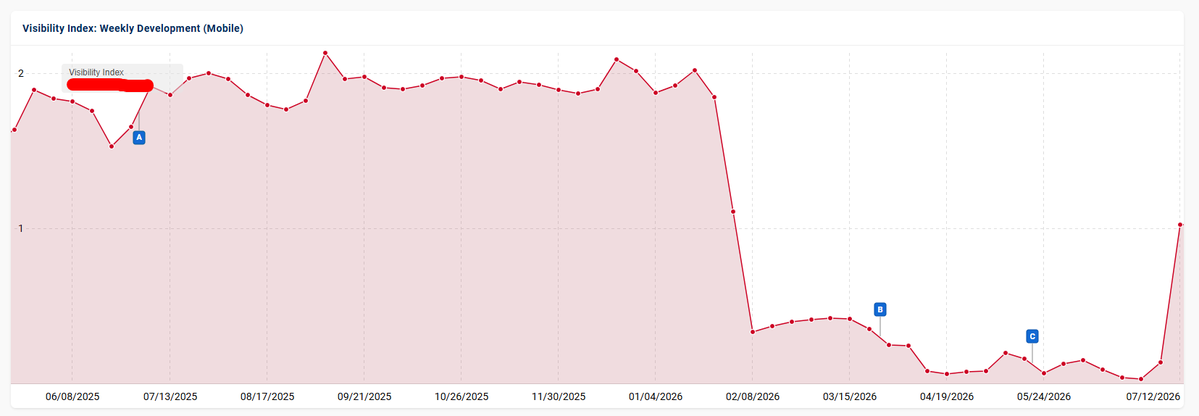
Google hammered sites running "commodity content" at scale, meaning how-to pieces so interchangeable that anyone could have written them. Self-serving listicles got hit too, the roundups that just happen to rank the publisher's own product at number one. Months on, most of those sites still hadn't come back. Our look at why listicle SEO is losing power in AI citations covers the AI side of that shift. More undifferentiated content now works as a demotion signal.
13. Broken sameAs URLs and invented schema properties
Two failures travel together here. There's no quotedPerson property in schema.org; on Quotation you want spokenByCharacter or creator. Made-up properties get dropped silently and can raise an "unrecognized property" flag in Search Console. A broken sameAs does its own damage. A URL that 404s, redirects to a hub or leads to a profile that has stopped naming the person does more harm than none, because it marks your entity data as unreliable.
Check every property against schema.org before you ship. Once a month, confirm that each sameAs link in your Organization and Person schemas still works.

Your competitors are getting cited by AI. You're not.
Every day without citation tracking is a day your competitors pull ahead in ChatGPT, Perplexity, and Claude.
14. Content over a year old with no refresh
Salespeak's freshness analysis puts roughly half of AI citations on content younger than 13 weeks, and older content fell out of the citation window on competitive queries. Leave your best pages untouched for a year and ChatGPT will quietly favor your competitors' fresher versions. Put your top pages on a quarterly refresh and update dateModified in the schema. Show a "Last updated" line, and never change the URL, so link equity carries over.
15. Skipping third-party distribution
Most SaaS content teams skip this one, and it's the biggest lever on the list. Stacker and Scrunch's research measured the lift, and an Ahrefs brand study explains why it works:
| Study | Finding |
|---|---|
| Stacker + Scrunch, March 2026 (87 stories, 30 clients, 2,600+ prompts, 8 AI platforms) | 239% median lift in AI search visibility from earned-media distribution |
| Ahrefs, 75,000 brands | Unlinked web mentions correlate 0.664 with AI citations, backlinks 0.218: roughly 3x the signal weight of a link |
Each quarter, publish at least one original data story that other outlets will want to pick up, then pitch it and distribute it. Mentions are where AI citations compound.
Bonus anti-pattern: chasing every AI engine equally
The engines overlap far less than you'd think:
| Finding | Number |
|---|---|
| Domains cited by both ChatGPT and Perplexity (SurfacedBy, 127K citations; Whitehat SEO's 118K-response study found the same pattern) | 11% |
| Sources cited by only one platform | 70% |
| Sources cited across all 5 major engines | 2.7% |
| ChatGPT's favorite: Wikipedia | 47.9% |
| Perplexity's favorite: Reddit | 46.7% |
| Google AIO's favorite: YouTube | 23.3% |
| Claude's favorite: blogs | 43.8% |
Pick two or three target engines based on what your buyers actually use, with a different content mix for each. Don't optimize for AI Overviews and Grok at once, because the winning content differs.
Lily Ray flagged a form of the "novelty spike" trap that turns up constantly in AEO dashboards:
This may be a hot take but being able to show something ranked at the top Google quickly isn’t really a huge flex… the real question is whether it consistently stays there. Lots of things rank really well for a short period because they are new.
 Lily Ray 😏@lilyraynycJul 11, 2026
Bragging about how fast a page got ranked or cited misses the point. New pages often spike simply because they're new, and what counts is whether they hold their place after that wears off. A week in ChatGPT followed by vanishing from every model's answers proves nothing about your strategy. It means you caught a signal the model is about to re-weight.
The community reality check
Over the past year, practitioners have gotten sharper about AEO, and their complaints match this list.
On r/SEO, someone with 25 years in the field said GEO today feels like mid-2000s SEO, with plenty of correlation guessing, thin evidence and vendors selling visibility scores averaged over made-up prompt baskets that no real user types:
GEO techniques and visibility monitoring is pretty much all snake oil
I’ve worked on SEO my whole career (25 years). So naturally the current paradigm shift is extremely interesting. So I’ve been going in deep and found that there’s surprisingly little evidence for a lot of what is bandied about. It’s nostalg...
He has nothing against monitoring. The mistake is trusting a vendor's composite score and reporting it up to leadership as if it meant something. The one signal he believes is dull: whether the model cites your domain at all, which Bing Webmaster Tools and your server logs already show.
A marketer who runs Florida pool companies wrote up what four months and $4,200 with an AEO agency bought him:
spent $4200 on an "AEO" agency for a pool business and got nothing. what am i missing??
i handle marketing for a few pool companys in FL. this year we noticed a chunk of leads were drying up even though rankings held steady. figured out people are asking chatgpt and perplexity stuff like "who should i hire to replaster my pool...
Rankings held, yet ChatGPT and Perplexity kept naming competitors for queries like "who should I hire to replaster my pool in Tampa." The agency's deliverables turned out to be backlinks and meta descriptions, a 2018 SEO package relabeled as AEO. His own earlier attempt with structured data and FAQ pages hadn't done much either. The trap is paying for "AEO" from a vendor that kept its old playbook and expecting the new name to move your AI citations.
What to fix first
Working through the list? This order gets you the most citation lift per hour:
| Fix | Notes |
|---|---|
| Descriptive URL slugs | A free 8.67 pp, won at publish time |
| Answer in the first 30% of every page | Rewrite openings to recover 2.5x retrieval |
| Remove Unicode fake-bold everywhere | Especially in LinkedIn content |
| Named entities in every paragraph | Rewrite generalities as specifics |
| Flatten redirect chains to 2 hops or fewer | Audit with Screaming Frog |
| Refresh your top 20-30 pages quarterly and update dateModified | Set the calendar reminder now |
| Fix schema fundamentals | Person, Organization, sameAs, and no fake properties |
| Distribute for earned media | One data-journalism piece per quarter, pitched |
Our content engine bakes fixes for most of these into every article it drafts. Our AI visibility tracking shows which pages are losing citation share, so your refresh priorities come from real signal instead of gut feel. For the positive version, our anatomy of a high-citation article breaks down the composite behind the citation share these anti-patterns destroy.
Most of these fixes are boring, and I won't pretend otherwise: the Unicode bold, the URL slug and the redirect chain take discipline more than creativity. Sites that win AI citations aren't doing anything clever. They've simply avoided the fifteen mistakes above. Put a reminder on the calendar, audit against this list each quarter, and by year-end you'll be ahead of 80% of your category.
200+ SaaS teams already track their AI citations.
They know exactly when ChatGPT mentions their brand, and when it stops. Do you?