
I keep getting asked, roughly weekly at this point, whether SEO is dead. Or GEO. Or whether GEO killed AEO. Or whether the correct term is now LLMO. Usually the person asking has read a takedown post from an SEO influencer, or a rebuttal post from a different SEO influencer, and wants a serious answer. Fair enough. Let me try to give a serious one, because the acronym cycle is genuinely exhausting and I think the underlying question actually matters.
I'm going to take a slight detour first, because the discourse itself is worth naming before I try to answer past it.
The Acronym Cycle Is a Discourse Problem, Not a Practice Problem
Every twelve to eighteen months, someone with a large enough following declares that SEO is dead and that the actual practice is now something else with a new acronym. In 2010 it was inbound. In 2015 it was content marketing. In 2019 it was topic clusters. In 2023 it was GEO. In 2025 it was AEO. In 2026 it's LLMO, or Answer Engine Optimization, or Generative Search Optimization, depending on which conference you attended last.
Each cycle produces roughly the same three articles: a takedown of the old term, a rebranding piece that positions the author's agency around the new one, and a "we told you so" retrospective 90 days later. The tactics don't actually change much between cycles. What changes is which acronym gets on the slide deck of the person selling you a $30K annual retainer.
Semrush called this out directly earlier in 2026:
GEO, AEO, LLMO. New acronyms, same tired take: “SEO is dead.” It’s not. Brands that write off Google organic are handing share to competitors, because audiences aren’t choosing between Google and AI. They’re using both. The winners treat search as one system. But measuring https://t.co/QDLJeBBy17
 Semrush@semrushFeb 26, 2026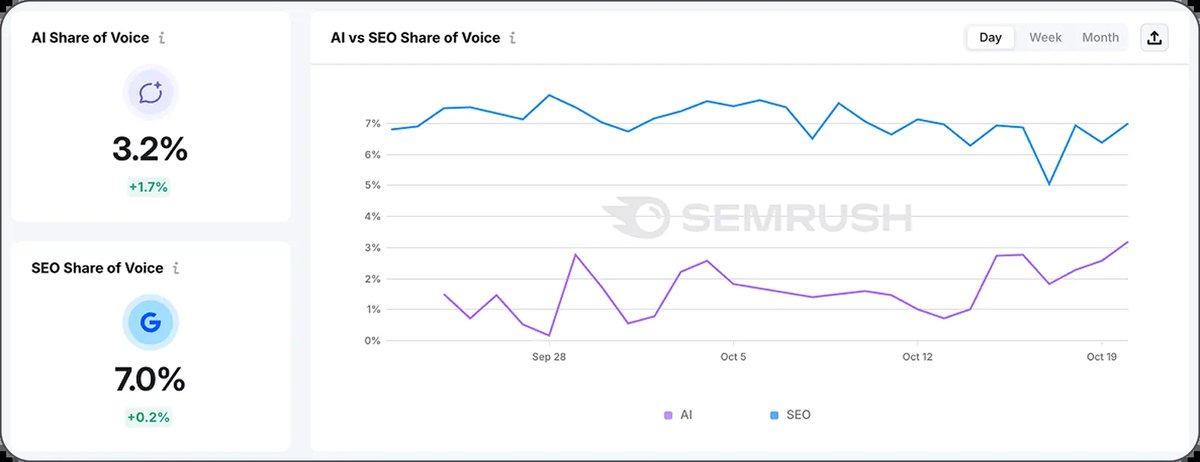
The point being that brands who write off Google organic hand the compounding share to competitors, because real users touch both surfaces. It's not one or the other. It's both, and the practitioners who are actually doing well have been saying this for eighteen months.
The Numbers Rebut "SEO Is Dead" Directly
Ethan Smith's team at Graphite ran the analysis in early 2026 with Similarweb clickstream data. Lily Ray flagged it:
This is a great new study by Ethan Smith, Graphite and @Similarweb that confirms a lot of the data I've been sharing in my talks and articles over the last year: despite the rapid growth of AI search, SEO is still not dead. Both things can be true at the same time: AI search
 Lily Ray 😏@lilyraynycJan 21, 2026
The specific findings: SEO traffic down only 2.5% year over year, search-engine visits actually up in 2025, AI Overviews on roughly 30% of searches, organic clicks still outnumber ad clicks by about 10x. Google's own Q1 2026 earnings then confirmed Search revenue up 19%. Which is not a dying channel; it's a compounding one.
Now, one honest complication. The Chartbeat publisher data is real: small publishers -60%, medium -47%, large -22% in the twelve months ending December 2025. That decline is severe and it is not a discourse artifact. But it's specifically publisher-side traffic, and it's driven by AI Overviews absorbing clicks that used to go to news sites. It's not the same thing as SEO being dead. It's the same thing as ad-monetized-publisher traffic being compressed while product-monetized-SaaS traffic behaves differently.
For a SaaS founder, that distinction is load-bearing. If you're getting cited by ChatGPT for "best CRM for a 20-person sales team," it doesn't matter that the click didn't happen. The buyer just saw your product name in an authoritative answer. Which is different from a news publisher that needs the click to display an ad.
Honestly, before I keep going, I want to acknowledge that the r/marketing community captured how the acronym debate feels to actual practitioners:
5 years in SEO: outdated. 3 months in AEO: visionary.
State of marketers at this point.
529 upvotes. The meme is that someone with five years of SEO experience gets treated as outdated while someone with three months of AEO experience gets treated as visionary. Which is a genuinely funny observation about how the acronym cycles operate socially. And it's a lot of why the debates persist: the acronym you use is a status marker, not a technique.
We'll show you exactly where your brand stands in AI search.
No commitment. $0 due today, cancel anytime. See how ChatGPT, Perplexity, Claude, Gemini, Grok, and Google AI Mode talk about your brand today.
Here's What I Actually Think Is Happening
The AI-era search environment is genuinely different from the 2019 environment in ways that matter. Six specific dynamics:
One. Answer surfaces (AI Overviews, AI Mode, ChatGPT answers, Perplexity answers) now intercept queries before the click. 68% zero-click per SparkToro's 2026 study.
Two. Citation share inside those answer surfaces has become a leading indicator that behaves like rank used to behave. The Ahrefs 1.4M-prompt study, Kevin Indig's 1.2M-response study, HubSpot's 642% lift experiment, and the SurfacedBy 127K-citation cross-engine study all converge on the same operational answer: URLs, first-30% placement, semantic-triple phrasing, freshness, schema.
Three. Cross-engine overlap is low (11% for ChatGPT+Perplexity, 2.7% across all five). So "AI visibility" is not one thing; it's engine-specific.
Four. Reddit, LinkedIn, YouTube, and Wikipedia are the load-bearing citation sources for most AI engines. Which means brand mentions on those platforms have first-class distribution value in a way they didn't have in 2019.
Five. Publisher-side traffic is genuinely compressing, and that compression is not going to reverse. Google's Q1 numbers, Chartbeat's data, and Reuters Institute Trends all point to a permanent redistribution of ad monetization from third-party publisher inventory to Google's owned surfaces.
Six. The unit economics of AI-generated answers are improving, not degrading. Google cut AI response costs 30%+ since the Gemini 3 upgrade. Which means AI answer surfaces will expand coverage into more query types, not retreat.
All six of those are real. None of them require you to call the discipline anything specific. They just require you to notice which specific structural signals now drive citation and traffic, and to ship them.
What Practitioners Are Saying Is What Actually Matters
The r/SEO community had a specific reaction to a GEO-influencer takedown video in June:
GEO Got Torched: THANK YOU
Wow. Wow, wow, wow! I've gotta rant here for a second. I know I'm 2 days late, but here it goes.. If you have not watched this absolute demolition of a GEO bro spouting his nonsense, only to get everything he thought he understood about AI...
152 upvotes, 173 comments. The consolidated read from the community: working SEOs get frustrated when the GEO/AEO acronym crowd claims novelty for things that competent SEO teams have been doing for two years. Structured data. Descriptive URLs. Comprehensive answer content. Freshness. E-E-A-T. Earned mentions. None of those are new. They're just now more decisively required because AI answer surfaces are the retrieval layer.
The Serious Answer to "What's Next?"
Here's what I actually tell people when they ask.
Nothing is next, because you're already in it. The AI-era search environment is here. It's called AI-era search. You don't need a new acronym. You need a specific tactical stack that maps to how AI engines actually retrieve content, and you need to run it every quarter with disciplined measurement.
The tactics that work are specific and finite. Descriptive URLs get you 8.67 percentage points more citation rate at publish. Semantic-triple structure produces 642% more page citations in HubSpot's experiment. Answer-in-first-30% catches 44.2% of citations per Kevin Indig's study. Quarterly refresh gets you 3.2x more citations per ConvertMate. Earned-media distribution delivers 239% median lift per Stacker + Scrunch. Track weekly citation share. Ship the moves. Measure results.
The acronym debate is a distraction. Whether you call this SEO, AEO, GEO, LLMO, or "the thing we do to be visible in AI answers," the work is the same. The teams that ship the six moves above outperform the teams that spend energy debating which acronym is definitionally correct. Every quarter I've watched this play out, the tactical operators beat the acronym theorists.
The uncomfortable truth is that most SEO agencies are simply rebranding. GEO agencies are SEO agencies with new slide templates. AEO agencies are SEO agencies with new methodology decks. There are a handful of new practitioners who came into the field specifically in the AI-search era who genuinely have a different perspective. But most of the "GEO expertise" is 12-year SEO practitioners who added Gemini and ChatGPT tracking to their existing playbook. Which is fine. The pretense that it's a completely new discipline is what's frustrating.
Backing up a step, here's the frame I use with clients. Search Engine Optimization was always the discipline of getting your content found through a computational retrieval layer. The retrieval layer used to be Google's SERP algorithm. Now it's an LLM's citation pipeline plus Google's SERP algorithm plus the AI Overview retrieval pipeline plus Bing's Copilot retrieval plus Perplexity's browsing agent plus Claude's practitioner-blog preferences. It's more surfaces, more variance, more measurement. But it's the same discipline: get your content found through a computational retrieval layer. Everything else is packaging.
Know exactly what AI says about your competitors.
RankControl's Recon Agent monitors competitor citations across ChatGPT, Perplexity, Claude, Gemini, Grok, and Google AI Mode. See where they show up and you don't.

What I'd Tell a Founder Reading This
If you're a SaaS founder trying to figure out whether to keep investing in SEO or pivot everything to GEO/AEO, here's the honest answer. Keep investing in the discipline. Don't get pulled into the acronym debate. Ship the six tactical moves I listed above. Rebalance your content distribution toward Reddit, LinkedIn, and YouTube where the mention economy is now growing. Track citation share weekly on the two or three AI engines your buyers actually use. Refresh your top 20-30 pages quarterly. Measure results.
If your existing SEO agency can't tell you what your ChatGPT citation share is, or what your semantic-triple coverage looks like, or where you sit in AI Mode's answer distribution for your top-15 target queries, they might be behind. But the fix isn't necessarily to fire them and hire a "GEO expert." The fix is to add the AI-answer measurement layer to your existing stack. Most competent SEO agencies can pick this up in a quarter. The ones that can't are the ones that have been coasting since 2019, and the coasting was going to catch up with them regardless of the acronym.
The content engine we run at RankControl covers the on-page part of these moves, with answer-first structure and schema built into drafting, and outreach from your own mailbox for backlinks. And our AI visibility tracking covers the citation-share side. But that's a plug for our specific product, and the honest answer to "what's next?" doesn't require our product. It requires you to ship the six moves consistently and to stop wasting energy on acronym debates.
The Meta Point
There's a version of this that isn't about SEO at all. Every discipline has an acronym cycle that generates status debates while the actual tactical work stays surprisingly stable. Growth marketing has one. Product management has one. Data science has one. In each case, the practitioners who spend their energy in the debates lose ground to the practitioners who spend their energy on the tactics.
SEO in 2026 is not different. The debates are entertaining. The tactics are what compound. Track citation share weekly. Ship the six moves. Refresh quarterly. Rebalance distribution. Ignore the acronym cycle. Come back in Q1 2027 and see whether the compounding worked.
Spoiler: it will. It always does. That's the whole point of the discipline, whatever you decide to call it.
For the strategic frame across all six major engines, see The 2026 State of AI Search: RankControl's Annual Report. For the full walk-through of the H1 events that reshaped the field, see our H1 2026 recap. The work is the same either way. The label you give it will change again in twelve months, and it won't matter then either. Ship the tactics.
One More Thing
If you've read this far and you're still frustrated by the acronym cycle, use it as a filter. The next time someone tells you SEO is dead, ask them what specific tactical stack they'd ship for the next quarter. If they can name six specific moves with data behind each, they're worth listening to regardless of the acronym they use. If they can only name the acronym itself, they're selling a rebrand rather than a discipline. The filter is that simple, and it will save you a lot of consulting fees and conference tickets over the next twelve months.
The acronym cycle will not end. Every twelve to eighteen months a new one will emerge, and someone with a large enough following will declare the previous one dead. Your job as a founder or marketing lead is to run the tactics that produce citation share and organic traffic, measure the outcomes, and let the label debates continue in the background. Every quarter I've watched teams that ignore the debates outperform teams that engage with them. That pattern is unlikely to change even as the specific labels do.
The next big label change will probably happen sometime in Q4 2026 or Q1 2027, when the next round of thought-leader posts positions "post-AEO" or "generative retrieval optimization" or whatever the successor acronym turns out to be. When that hits, come back to this piece. The tactics will still be the same. The compounding will still work. The work will still be the work.
26 content formats. Published on your domain. Matched to your brand.
Guides, comparisons, listicles, case studies, and more. RankControl generates content that gets cited by ChatGPT, Perplexity, Claude, Gemini, Grok, and Google AI Mode.