
If you've searched Google lately, you already know what I'm about to say: the top of the results page belongs to Gemini now. It makes no difference whether you land on an AI Overview or click over to AI Mode. The answer above the fold is written by Gemini 3.5 Flash, and it isn't picked from the organic results underneath. SEO people have been predicting this for two years. What's new is that the shift has a model name and a rollout window, May 2026, and you can measure what it did to your organic click share against where you were twelve months ago.
The news: Gemini 3.5 Flash is the SERP
Google made it official at I/O. Sundar Pichai announced the biggest Search box redesign in 25+ years, and for you the important part is the model underneath it. Gemini 3.5 Flash became the default AI Mode model everywhere, and nobody needs a subscription to get it.
| Where Google said it | What it said |
|---|---|
| Google I/O 2026 (May 19-20) | Gemini 3.5 Flash is the default AI Mode model globally, rolling out to approximately 200 countries and 98 languages |
| Same event | AI Mode passed 1 billion monthly active users, with queries "more than doubling every quarter since launch" |
| Q1 earnings call (April 29) | AI Overviews surpassed 2 billion monthly users across 200+ countries and 40 languages |
| Same call | Search revenue grew 19% in the quarter, and net income was up 81% |
The earnings call came two months before I/O, and I'd argue it said more. Right alongside that revenue growth, Pichai told investors that "people love AI experiences like AI Mode and AI Overviews, and they're coming back to search more." I can't think of a stronger signal Google could send that the AI-first results page is the permanent shape of its product.
Lily Ray captured the strategic picture during the I/O keynote.
AI Overviews have 2.5 billion MAUs, AI Mode has 1 billion MAUs When people use AI Mode, they use search more People are asking AI in Google Maps much more complex questions People are using the new "Ask YouTube" AI feature for complex/personal queries #GoogleIO @googleio https://t.co/hVkaiy6K72
 Lily Ray 😏@lilyraynycMay 19, 2026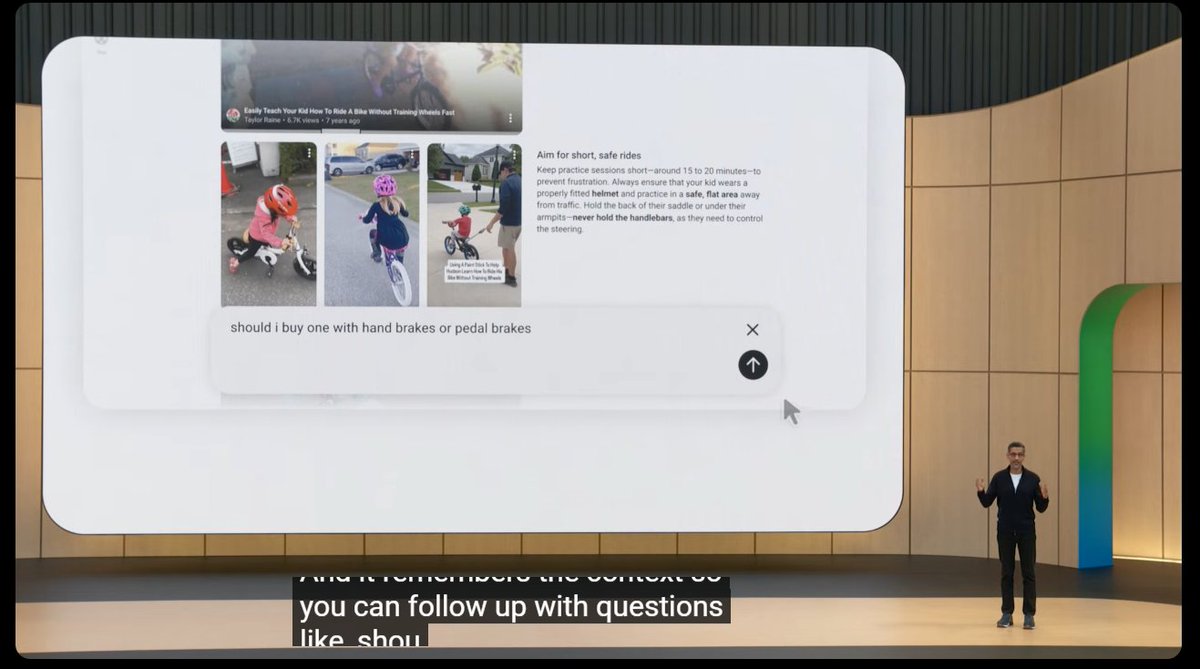
If you've been telling yourself that AI search will settle down and organic will come back, you now have to square that belief with 2B+ monthly users on AI Overviews and 1B on AI Mode.
What changed on the SERP itself
You can measure the change in pixels before you even open your traffic reports.
| On the page | Now |
|---|---|
| Average AI Overview height (SQ Magazine's 2026 analysis) | Over 1,200 pixels, up 15% year over year |
| Screen an average Overview fills on a 900-pixel viewport | All of it |
| Where the first organic result starts | Roughly 1,674 pixels below the top, completely below the fold on a standard desktop |
| AI Overview share of the screen | About 48% on mobile, 42% on desktop |
| AIO-triggered queries that happen on mobile | 81% |
| Top-10 organic results' share of AI Overview citations (Ahrefs, reported May 2026) | 38%, down from 76% in July 2025 |
| Zero-click rate on AIO-triggered queries | Up from 54% to 72% in nine months |
In plain terms, a desktop searcher sees the Overview and nothing else until they scroll. Your buyer probably isn't on desktop, though. Most AIO-triggered searches happen on mobile, where the Overview claims an even bigger share of the screen, so in most SaaS categories nobody sees your first organic listing unless they deliberately scroll for it.
The citation numbers are what I'd put in front of your CEO. The top ten's share of AI Overview citations halved, from 76% to 38%.
Ahrefs also confirmed that when an Overview triggers, it sits at the top of the page 85% of the time. So the old routine of ranking in the top ten and collecting the clicks is now measurably less effective, by a factor of 2x. Rank still counts, but it's competing for a much smaller click surface.
You can see the same thing at ground level in the r/SEO threads from April and June 2026.
My traffic has been all over the place for 2 months — think it's AI Overviews but not sure how to fix it. Any advice?
So for the past couple of months my organic traffic has been really inconsistent. Rankings are mostly holding but clicks are noticeably down on pages that used to perform well. I'm pretty sure AI Overviews are eating into it — some of my be...
Read a few of them and the picture is consistent. Traffic is choppy and position 1 doesn't hold the click surface it used to. The sites that are growing are the ones mentioned inside AI Overviews, and a top-ten rank on its own isn't doing it for anyone.
Your competitors are getting cited by AI. You're not.
Every day without citation tracking is a day your competitors pull ahead in ChatGPT, Perplexity, and Claude.
The intent shift that matters most for SaaS
The finding I'd build your plan around comes from Semrush's 600K-keyword study, and I think it's the most important strategic result of the quarter.
Two very different trajectories for AI Overviews: 📈 +71% on commercial-intent searches (research mode) 📉 −5% on transactional-intent searches (ready-to-buy mode) Translation: AI Overviews are showing up earlier in the buyer journey – while people are still comparing, not https://t.co/gY8QMIE8Ms
 Semrush@semrushJul 11, 2026
| Semrush study, published July 11, 2026 | Change in AI Overview presence |
|---|---|
| Commercial-intent (research-mode) searches | Up 71% |
| Transactional-intent queries | Down 5% |
Google is putting Gemini answers earlier in the buyer journey, where people are still comparing, and pulling back where they're ready to check out. That comparing phase is exactly where SaaS discovery lives, which is why this study worries me more than any traffic chart.
Say you're targeting "best CRM for a 20-person sales team" or "Slack vs Teams for engineering." Gemini now sits between your buyer and the ten organic listings that used to matter. On "buy [specific product]" queries, AI Overviews are actually receding.
So my read is that the higher a query sits in the funnel, the more your target is a citation inside Gemini's answer rather than a click to your homepage.
An r/SEO thread from June captured the operational math
Click-through rates down due to AI Overview, but more overall traffic: could we actually have more total clicks?
In a Facebook SEO community, one of the most active users, who considers himself a true expert professional, wrote this (I translate from Italian): Many marketers are concerned about SparkToro's latest study: in 2026, "zero-click" searches...
The thread splits into two camps. Some sites report CTR down but total visits stable or even up, because their impressions grew when AI Overviews amplified their citation reach. Others see both numbers dropping. What separates them is whether the site got cited inside the Overview or just ranked below it, and that's why I now treat citation as the leading indicator and rank as a secondary one.
How to adapt: three moves for H2 2026
Here's what I'd do in your position for the rest of the year.
First, chase commercial-intent citations instead of commercial-intent rankings. That jump in AI Overviews on commercial queries is the strongest signal in all of this, so every "best of" listicle, comparison and category-defining post you ship should be built to be cited inside an AI Overview answer.
In practice that means a descriptive URL, the answer inside the first 30% of the page, semantic-triple phrasing and an update within the last 13 weeks. It's the playbook the Ahrefs 1.4M-prompt study findings point to. Kevin Indig's 44.2%-in-first-30% number says the same thing about where your answer should sit.
Second, invest in earned media distribution. The strongest evidence comes from Stacker and Scrunch, whose 2026 study documented a 239% median lift in AI search visibility from earned-media distribution.
| Stacker + Scrunch 2026 study | Scope |
|---|---|
| Stories | 87 |
| Clients | 30 |
| Prompts | 2,600+ |
| AI platforms | 8 |
AI Overviews cite third-party sources heavily. That's why getting your data or product mentioned in a trade publication now tracks more closely with AIO citation share than shipping one more blog post on your own domain.
200+ SaaS teams already track their AI citations.
They know exactly when ChatGPT mentions their brand, and when it stops. Do you?
Third, make citation share the number you track first. Your old dashboard of rank plus estimated traffic misses the leading indicator. What actually predicts pipeline for the rest of the year is how often your brand shows up inside AI Mode and AI Overview answers for the queries you target. Ahrefs Brand Radar, the free AI Performance report in Bing Webmaster Tools, and our AI visibility tracking all cover it. Rank has become a lagging indicator of citation share, and it doesn't work the other way around.
The bigger picture
I don't expect Google to walk any of this back. Gemini at the top of the SERP isn't a temporary experiment, and Google's own first-quarter numbers, from the AI Overview user count to the revenue and profit growth, tell me the AI-first SERP is the permanent product. The SEO strategies that make it through the second half of the year will treat citation share as the main target and rank as a consequence of it.
If you want the citation-share tactics in more detail, our content engine breakdown walks through them. For the strategic frame, The 2026 State of AI Search: RankControl's Annual Report has the consolidated numbers across all six major engines.
Rank still matters. After this year's Ahrefs and Semrush numbers, though, I don't think anyone can seriously argue that it matters more than citation share.
How often does ChatGPT mention your brand?
Most founders have no idea. The answer might surprise you.