
Substack isn't in the top 50 domains AI engines cite, and neither is Beehiiv or any other newsletter platform. That absence is the most interesting fact in editorial AEO right now, because the structural ingredients are there: named authors, long-form expertise, public archives, and RSS feeds that AI crawlers actually follow. Newsletter platforms miss the citation indexes for reasons that have almost nothing to do with content quality and almost everything to do with a paywall pattern that hides the best editorial work behind an email address.
This is the AEO guide for newsletter operators, Substack pubs and editorial brands, sixth in our vertical guide series next to the enterprise AEO playbook. The lift is smaller than in healthcare or fintech (no compliance layer to build), but the mechanical problems are unusually specific to the format.
What AI actually cites for editorial queries
The 5WPR AI Platform Citation Source Index 2026, which synthesizes nine datasets covering hundreds of millions of citations, puts Reddit and Wikipedia together at roughly 25% of ChatGPT citations. Brands' own sites get a small share. Profound's analysis of 27 million AI citations found 95.7% of category-level citations come from third-party sources rather than the brand's own site. On branded queries, only 23% of AI citations come from the brand's website, with the other 77% going to reviews, forums and editorial coverage.
Each engine also has its own favorite sources:
| Engine | Sources it leans on |
|---|---|
| Google AI Overviews | The New York Times appears in over 96% of AI Overviews for relevant queries |
| Claude | NYT, The Atlantic, The New Yorker and The Economist |
| ChatGPT | Wikipedia, Reddit, Forbes and Business Insider |
| Perplexity | Primary sources, NIH/PubMed and named B2B authorities |
They overlap very little: ChatGPT and Perplexity share only 11% of cited domains.
Reddit and Wikipedia account for 25% of ChatGPT citations. It's hard to control what Wikipedia says. It's hard to control what Reddit says. Meanwhile, 75% of AI citations come from sources you can influence. That is where the opportunity is for brands. [Want to know where https://t.co/1mDTESvf2i
 Alex Groberman@alexgrobermanJun 19, 2026
Alex Groberman put the takeaway concisely earlier this year. Reddit and Wikipedia together are 25% of ChatGPT citations, and you can't control what either of them says about you. The other 75% comes from editorial publications, industry sites and niche authority content. A newsletter operator can build exactly that, week by week.
The Substack ecosystem in mid-2026
Substack reached $45M in annualized revenue by July 2025 and a $1.1B valuation through its Series C, with more than 5M paid subscriptions and roughly $450M in aggregate writer revenue. It has been cash-flow positive since Q1 2025 and hasn't filed for an IPO yet. Its 10% cut of paid subscriptions has pushed higher-revenue creators toward Beehiiv (SaaS pricing, no revenue cut) and Ghost (0% platform fees, open source).
For AEO, three platform differences matter more than pricing.
Substack ships a public archive with substack.com's Domain Authority behind it, plus RSS at [publication].substack.com/feed, a public JSON API with no authentication, and basic SEO settings for titles and descriptions. What it doesn't ship is canonical URL overrides, a custom robots.txt or much schema markup control. Because the paywall is server-side, a 3,000-word paywalled post renders to GPTBot, PerplexityBot and ClaudeBot as a roughly 300-word preview.
Beehiiv skews toward audience growth mechanics rather than AEO controls. It hit $30M ARR by June 2025, up 52% from year-end 2024, and in 2025 sent 28 billion emails to 255M unique readers across 65,000-plus active newsletters. The Boost network (creator-to-creator paid subscriber acquisition) contributed $10M of that revenue.
Ghost is the open-source option, with 0% platform fees, full control over the custom domain, schema markup and robots.txt, and JSON and RSS feed support, either self-hosted or as managed Ghost(Pro). Ghost publications collectively earn $100M-plus a year.
Kit (formerly ConvertKit) added an explicit AI crawler permissions toggle in early 2026 that lets operators allow OpenAI Search, PerplexityBot and Apple to index member content, along with DuckDuckGo and Yandex. Explicit AI crawler consent controls like this are where every platform is heading over the next twelve months.
The paywall problem
Mechanically, the problem is stark. Substack's server-side paywall returns only the free preview HTML to crawlers. If your best analysis lives behind that wall, GPTBot sees the 300-word preview and never the 3,000-word article. One newsletter operator documented on AmICited.com switched from a full paywall to a metered access model and saw AI visibility increase 400%, a real number rather than a promise.
Blocking AI crawlers entirely, the News Corp negotiating tactic, works if your goal is to force a licensing deal. It fails if your goal is to be cited in ChatGPT tomorrow. Models trained on older web snapshots can reconstruct content from cached snippets, but reconstruction doesn't generate citation credit, and an article whose live URL GPTBot can't fetch never enters the citation pool for new queries.
The tiered content pattern that works has three layers:
| Layer | What it holds | AEO role |
|---|---|---|
| Discovery | Free posts with named authors, structured data and open RSS/JSON | The AI-visible surface |
| Membership | Preview-then-paywall on premium analysis | The free excerpt is engineered to earn citations that route qualified readers to the paywall |
| Community | Forums, Discord, calls, subscriber-only Q&A | Zero AEO value, full retention value |
For the robots.txt directives that let each AI vendor's crawler read your public discovery layer, our complete AI crawler list has the token-by-token reference.
Know exactly what AI says about your competitors.
RankControl's Recon Agent monitors competitor citations across ChatGPT, Perplexity, Claude, Gemini, Grok, and Google AI Mode. See where they show up and you don't.

RSS, JSON feeds, and how AI actually ingests newsletters
RSS and JSON feeds were one of the dominant AI crawler traffic categories in 2025 and 2026. That's worth pausing on. Substack's [publication].substack.com/feed, Ghost's /rss/ endpoint and the JSON Feed spec at jsonfeed.org all expose full article lists, titles, descriptions and free-tier content directly, and AI companies harvest tokens from these feeds continuously.
So don't block your RSS feed. It's one of the highest-value AI discovery paths available, and leaving it open costs nothing. For public posts, put the full text in the feed rather than excerpts. AI ingestion prefers the full HTML. Then publish a valid <link rel="alternate" type="application/rss+xml"> in the HTML head so crawlers can find the feed from any page.
If you run on Ghost or a custom stack, ship a dedicated /api/ai/creators.jsonld or an equivalent structured JSON-LD endpoint. Direct machine-readable creator and article data is unusually easy for AI crawlers to parse and cite.
Author E-E-A-T is the editorial category's biggest lever
A named byline carries a 1.40 citation odds ratio against 1.12 for anonymous content, a roughly 25% lift for having a real byline. The same signal runs through AI Overviews, where 96% of content comes from sources with verified E-E-A-T signals. When Semrush studied 304,805 AI-cited URLs in January 2026, E-E-A-T signals delivered a +30.64% citation lift, behind only clarity and summarization quality at +32.83%.
Content with 1 very specific characteristic gets cited by AI platforms 1.8x more often. If you want to know exactly what ChatGPT, Claude and broader AI search platforms are looking for when they decide which content to cite, the data is now specific enough to act on. According https://t.co/VwrelHUAXH
Alex Groberman@alexgrobermanJun 29, 2026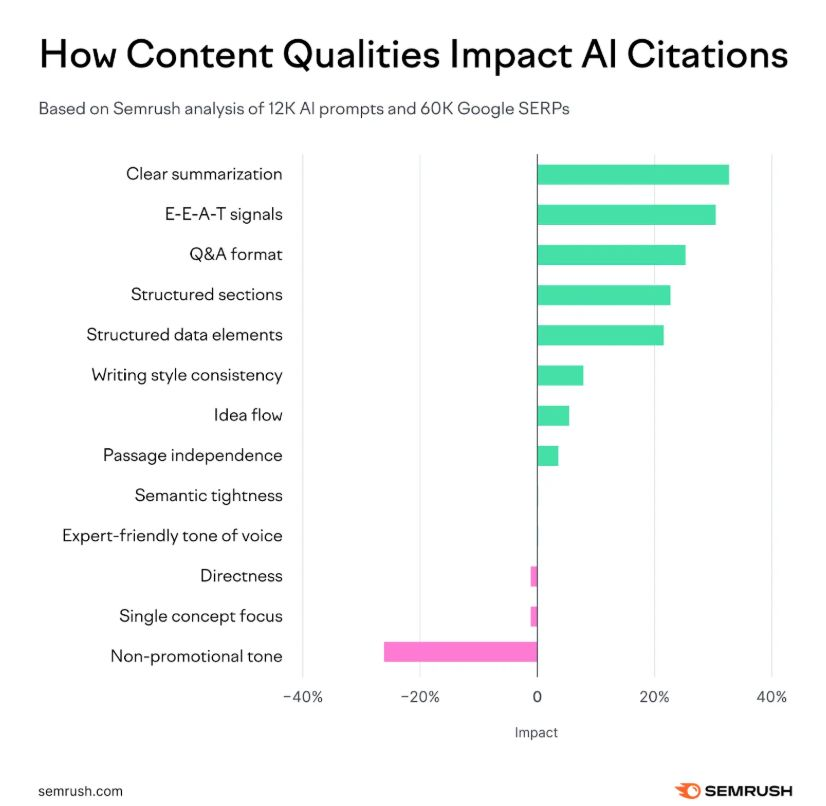
The 1.8x factor Groberman surfaced from that Semrush study is the compounding effect. One very specific characteristic (originality of data or primary research, tight formatting, clear E-E-A-T) is worth almost double the citation likelihood of the average piece.
Practical E-E-A-T starts with a named byline on every post, since "Staff Writer" or the publication name alone assigns authority to no one. Each author needs a full author page with a bio, prior publication bylines and verified social profiles, plus book publications, awards and topic expertise signals. Link the Article schema to the Person schema via @id identifiers, and include knowsAbout fields listing the topic domain the author covers.
Then there's beat consistency. Writing about one topic for years is a stronger authority signal than a broader mix, and AI citation systems weight topical authority heavily.
AI engines actively read certain journalistic credentials as signals. NYT, WSJ and Bloomberg bylines count as prior work, and so do book publications indexed on Amazon and award mentions with dates and issuing bodies. Specific beat coverage that shows up in Google Scholar or archived press coverage counts too.
The editorial schema stack
Three schema types carry most of the weight:
| Schema type | Where it goes | Properties to include |
|---|---|---|
BlogPosting (or NewsArticle for time-sensitive reporting) | Each post | author, datePublished, dateModified, publisher, headline, description |
Person | Every author bio | name, url, sameAs (LinkedIn, Twitter), knowsAbout (topic list), jobTitle, worksFor |
Organization | The publication entity | name, url, logo, sameAs (all public profiles) |
Keep one canonical Organization and Person graph, linked by stable @id identifiers across every post, and test it with Google's Rich Results Test. For paywalled sections, use isAccessibleForFree: false on the hasPart structured data so Google's paywall handling still gives credit to the free preview.
The speakable property, still in Google beta, marks sections suitable for voice assistant playback. If your newsletter has strong pull quotes and direct-answer capsules, ship speakable on those sections, because voice-assistant citation is a growing surface.
Off-site signals: LinkedIn just passed everyone else
LinkedIn moved faster than any other off-site channel in 2026. It rose from #11 in ChatGPT citation rankings in November 2025 to #5 by February 2026, the largest authority shift the citation-tracking industry has documented. Individual member content, not company pages, accounts for 59% of LinkedIn citations. Named authors publishing substantive posts drove the shift.
That puts LinkedIn first in the off-site priority stack, with the author publishing substantive, bylined thought-leadership posts as a named contributor, not through company pages.
Medium is second: republish your best content there with a canonical tag pointing back to the original. Substack doesn't allow canonical URL overrides. If your best content lives on Substack, publish on your own domain first and republish to Substack second. If it lives on Ghost, use canonicals on both the Medium and LinkedIn republications.
Time-sensitive newsletters should go after Google News eligibility next. That takes NewsArticle schema, original reporting, consistent bylines and HTTPS, and as of March 2025 Google News is fully automated, with no manual application. YouTube comes next, for transcripts of newsletter summaries or explainers. Video transcripts are among the highest AI citation sources.
Larger publications can pursue Wikipedia where an organic entry is achievable, though it takes 12 to 24 months for most brands and requires coverage in multiple independent secondary sources. Last come Twitter/X thread summaries of key findings from data-heavy newsletters.
26 content formats. Published on your domain. Matched to your brand.
Guides, comparisons, listicles, case studies, and more. RankControl generates content that gets cited by ChatGPT, Perplexity, Claude, Gemini, Grok, and Google AI Mode.

The ten mistakes that erase editorial brands from AI
The ten most common patterns fall into four groups.
Three are about access. Paywalling everything gives AI nothing to cite, email-only distribution with no public web archive does the same, and blocking or omitting RSS feed access closes the discovery path described above.
Two are about the author. "Staff Writer" or unattributed bylines assign no authorial authority, and with no entity graph on the author, AI can't resolve the byline across LinkedIn, Google Scholar, prior publications and books to build citation confidence.
Three are technical. One is having no Article/BlogPosting schema, or schema that isn't linked to Person and Organization. Another is a canonical URL mismatch when syndicating to Medium, LinkedIn or Substack that gets the wrong version cited. The third is native Substack posts without a custom domain. They forfeit brand-equity URL structure.
The last two are about positioning and rhythm. Vague topical positioning ("tech stuff") surrenders beat authority, and an inconsistent publishing cadence hurts because 65% of AI bot traffic targets content from the past year.
The industry's state-of-play numbers are clear enough. Paid newsletter subscriptions have tripled since 2021, and Beehiiv's paid subscription revenue rose 138% in 2025. Newsletter operators are already inheriting the reader relationship that traditional publishers ceded.
What's open is whether editorial brands claim the AI citation graph now, while the top-50 domain slots are still being contested, or wait until the pattern locks in and every citation goes to Reddit and Wikipedia. RankControl checks citation share for editorial brands across six engines every week, so the citation-rate line item lands in the dashboard week by week rather than quarter by quarter.

Your competitors are getting cited by AI. You're not.
Every day without citation tracking is a day your competitors pull ahead in ChatGPT, Perplexity, and Claude.