
On September 27 we pulled a sample of posts from our own blog and checked which ones Google had indexed. Every one of the ten July posts we picked was in. Of ten posts published between September 13 and 20, only five were.
There was nothing wrong with the missing five. They were a week or two old, and indexing can take that long. Had we judged them on those first two weeks, though, we'd have written off half of a normal batch.
That's what makes tracking published articles tricky. Each article runs on its own schedule, so the question worth asking at week two isn't the one worth asking at month six. Below, stage by stage, you'll see what to track for each article and when it's worth acting. We checked every source on September 27, 2026.
Every article runs on its own clock
A site-wide dashboard blends your new articles with your old ones. If last year's posts have a strong month, that total can hide a new post Google never indexed. You only catch that by tracking each article on its own.
We call the fix the article clock. Every check below counts from the article's publish date rather than the calendar, so a post that went live on the 28th doesn't get judged in that month's report.
Think of the clock in three stretches. The first two weeks are for indexing, and the first two months for impressions and early rankings. AI citations come last, and as you'll see further down, they usually take longer than either.
Days 0 to 14: get it indexed
Until Google has the page in its index, rankings and citations can't start, so that's your first check. Google's own guidance tells you what to expect:
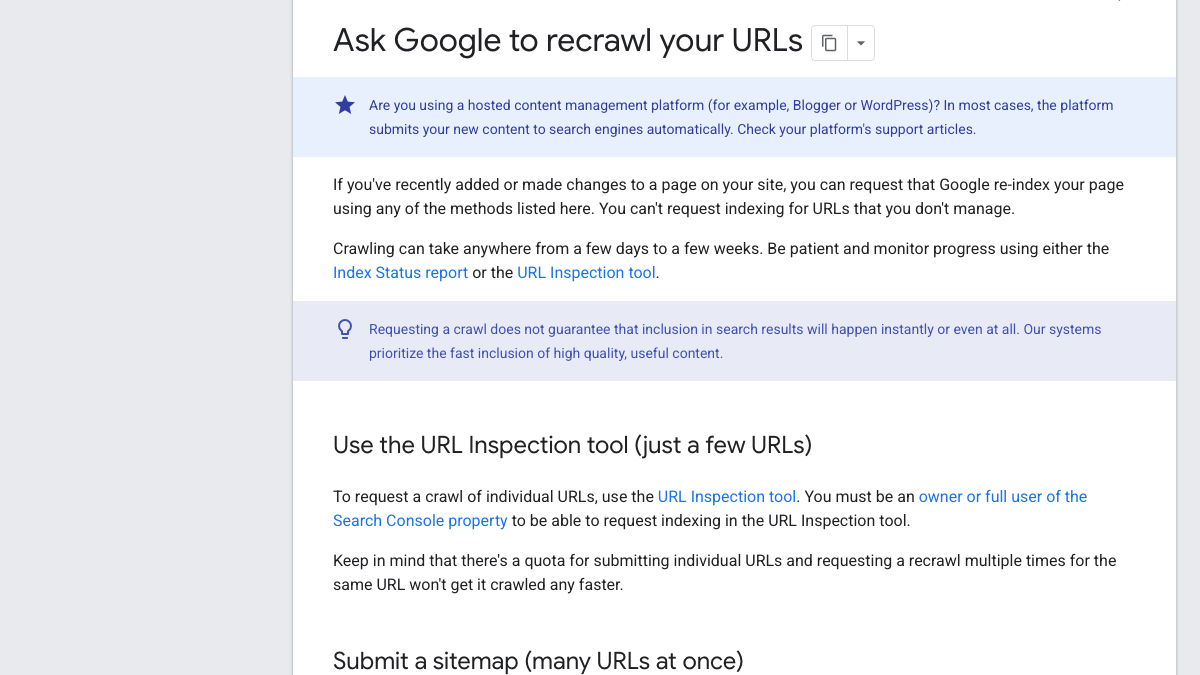
On publish day, inspect the new URL in Search Console and request indexing once. Look again on day 3, day 7 and day 14. The same Google page says asking again won't speed anything up, so one request is enough.
You'll get further by showing Google that the page matters. Link to it from relevant pages that already get traffic, and check that it's in your sitemap. A sitemap on its own won't do it, as John Mueller pointed out earlier this year: Google has to be keen on indexing more content from the site before it uses the sitemap.
Sitemaps aren't a directive. You still need to prove a site's worth to Google... -> From John: "One part of sitemaps is that Google has to be keen on indexing more content from the site. If Google's not convinced that there's new & important content to index, it won't use the
 Glenn Gabe@glenngabeFeb 23, 2026
Submit the URL in Bing Webmaster Tools as well. Bing's index feeds Copilot, and ChatGPT has leaned on Bing for its search results.
Three weeks in, if the page still isn't indexed and Search Console lists it as "crawled - currently not indexed," read that as a verdict on the page's quality. Our guide to telling thin content from an authority problem helps you work out which one you're facing.
You're getting AI traffic. But do you know where it comes from?
RankControl credits every visit to the assistant that sent it: ChatGPT, Perplexity, Claude, Gemini, Copilot, or Grok. Full source attribution, next to your Google traffic.
Weeks 2 to 8: impressions and early rankings
After indexing, filter Search Console's performance report down to that single page. Each week, note its impressions and the queries it shows up for. Then check where it sits for its main query.
Don't read much into the first few days, because new articles often land high and then slide. In August a blogger on r/bigseo described exactly that: every new post ranked well for four or five days and then disappeared from the results.
My blog posts rank for a few days, then completely disappear. Has anyone experienced this?
I'm having a strange problem that I can't seem to figure out. Everytime I publish a new blog post, it gets indexed and typically ranks well for about 4-5 days, and then it just completely disappears from the search results, even when checki...
The replies are worth reading before you panic about your own posts. One commenter suspected a canonical problem, because the poster had seen tag archive pages turning up where the posts should have been. Another explained that early positions are provisional, and that a new page with no links or engagement often settles lower. If you track each article by its URL, you'll spot either cause quickly.
Give the queries list as much attention as the position. Articles tend to rank for long, specific searches before they rank for their main keyword. Those long-tail queries show you whether Google has understood what your page is about.
Months 1 to 6: AI citations take longer
Expect AI citations to trail your rankings. In August, an AI visibility tracker posted data in r/aeo on how old pages were when an engine was first recorded citing them. The median page was 203 days old, and only 9% of cited pages were less than a month old.
New pages can still get cited. We've seen a small insurance agency's article picked up by two engines six days after it went live, on a narrow question about professional liability costs for IT consultants. For most topics, though, you can't judge an article's AI results in its first two months.
Later in an article's life, keeping it current starts to pay. When we checked which pages AI engines cited for 12 B2B questions, the median cited page carried a July 2026 date. That made it about five months newer than the median Google top-10 page the engines passed over, and our guide to what moves AI search visibility covers the check. So a post from last year that you've kept current can beat a brand-new one as a citation candidate.
To track an article's citations, write down the two or three questions it answers and add them to your regular question set. Run them on at least two engines. ChatGPT and Google's AI Overviews often cite different pages for the same question, which is what our check of AI citations against Google rankings found.
Your server logs belong in this too. A page that AI crawlers haven't fetched can't be cited, so make sure they're visiting it. Our guide to tracking AI crawlers in server logs shows you how.
What to record for each article
One spreadsheet with a row per article covers most of it:
| What to track | Where it comes from | When to check |
|---|---|---|
| Indexed or not | Search Console URL Inspection | Days 3, 7 and 14 |
| Impressions and queries | Search Console, filtered to the page | Weekly for 8 weeks, then monthly |
| Position for the main query | Search Console or a rank tracker | Weekly |
| AI citations for its questions | Your fixed question set, run on each engine | Monthly from month 2 |
| AI crawler visits | Server logs | Monthly |
| Visits, AI referrals and conversions | Google Analytics 4 | Monthly |
Put the publish date in that row, along with the date of every update. Add the two or three questions the article targets and the internal pages linking to it. Then, when a number moves, you can tell whether it moved after something you changed or on its own.
We'll show you exactly where your brand stands in AI search.
No commitment. $0 due today, cancel anytime. See how ChatGPT, Perplexity, Claude, Gemini, Grok, Google AI Mode, and Google AI Overviews talk about your brand today.

Reading the trajectory
The shape of each article's line tells you what to do next. So what does each shape usually mean?
If three weeks pass without indexing, Google doesn't yet see the page as worth indexing. Improve the page, then link to it from stronger ones. A page that gets impressions but whose position is still stuck beyond 20 after three months usually has a content gap or an authority limit.
The pattern to act on is a page that ranked steadily for months and then dropped. That one's a candidate for a refresh, or for a merge if another page on your site now competes with it for the same queries.
Don't treat a lost citation as an emergency. An analysis of 3.5 million citation events found that half of ChatGPT's citations in a given week were gone within about 3.4 weeks, so citations coming and going is normal. What should worry you is a steady decline across several checks.
An article that gets cited but sends few visits isn't failing either. Many AI answers name or cite a page without sending a click, so look at branded search impressions and conversions from AI referrals before you judge it on traffic.
And if an article is performing steadily, leave it alone. A rewrite done only to make it "fresh" can cost you the rankings and citations it already has.
Compare cohorts of articles
Cohorts are how you zoom out. Group your articles by the month they went live, then compare each group at the same age.
Day 30 gives you the early read: what share of that month's articles were indexed by then? By day 90, look at the share ranking in the top 20. By day 180, look at the share an AI engine has cited.
This is the view that answers what leadership actually asks you, which is whether the content program is working. It also shows whether a change you made, like a new brief template or better internal linking, improved results for the articles published after it.
Doing all of this by hand adds up. Publishing eight solid articles a month takes 16 to 24 hours. Checking 50 questions on seven engines takes about six hours a week, and per-article tracking comes on top of both. Those are rough estimates.
RankControl handles most of this loop for you. Our content engine writes each article against the pages already ranking for its keyword and publishes it on your own domain. AI visibility tracking runs your 50 questions every week on seven engines and marks each one as mentioned, cited or both, next to your Google and Bing rankings. When rankings or citations slip, RankControl flags the page and rewrites it once you approve.
The article clock needs nothing more than Search Console, a spreadsheet and a calendar reminder, so you can run it yourself. If you'd rather your team spent its time deciding which articles to update, RankControl's agents can keep the tracking going.
Know exactly what AI says about your competitors.
RankControl's Recon Agent monitors competitor citations across ChatGPT, Perplexity, Claude, Gemini, Grok, Google AI Mode, and Google AI Overviews. See where they show up and you don't.